Friday, October 4, 2013

Right Great Ride Routes to Remember

.

Back in the middle of August, I was riding around one Saturday, and stopped at the Holly Springs Country Store for a little rest, and to wet my whistle.  As I turned into the driveway, I spotted a young man dribbling motor oil from well above the filler opening, trying to get some to go into the crankcase of his Yamaha V-Star metric cruiser. 

I stopped nearby, took off my gloves and helmet, then walked over to see if I could help him.  He had no funnel, and he was getting more oil on the pavement than into the gizzard of his bike.  I held the bike up straight for him so he could pour more accurately. 

He finished his pouring, and thanked me for helping, then introduced himself as Jay.  As we were talking, I noticed that his license tag was from Florida, and he had some luggage on the tail of the bike. I asked him about his ride today and how long he had been riding. 

He was a talkative guy, and explained the details of how he came to own a motorcycle, and why he was there today.  He said he had become interested in riding some months ago, traded his old car even for the bike, and only then took a class to learn how to ride it.  He said it sat in the garage until he took that class.  That seems smart to me.  That's what I did back in 2007.  Now carless, he rides the scooter wherever he goes if he can't walk there.  He says he has ridden about 4000 miles so far, and had never been on roads that were not flat before this trip.

He related that he had just come down from Sassafras Mountain, the highest point in South Carolina, about 12 miles from the store.  It is a place I have visited many times before, at Pushpin B (Pushpin A is where the store is located):   

View Larger Map

He said that Sassafras was the last of the highest points in seven states he had visited over a period of a week.  He didn’t have much with him -- a tent, a sleeping bag, and a small clothes bag strapped onto the bike, and he said that he had spent all of $90 on lodging for the week.  

Interesting.  I wondered where these seven peaks are.  

I looked up the Seven Summits Tour on the Internet, but came up with something a lot different: Many people, extreme adventurers, think of climbing to the highest points on the seven continents when they hear about Seven Summits. 

These:
  • North America’s Denali,
  • South America’s Aconcagua,
  • Asia’s Mount Everest,
  • Europe’s Mount Elbrus,
  • Africa’s Kilimanjaro,
  • Australia ‘s Mount Kosciuszko, and
  • Antarctica’s Vinson Massif.
For those who are less adventuresome ‑‑ and who have shallower pockets ‑‑ the seven might instead be the highest points in seven southeastern states, listed here with their elevations above sea level: 

All of these high points have roads to or nearly to their tops, so you don't have to turn up your pacemaker to get to any of them, and you can leave your hiking boots behind.  For someone who has only previously ridden on flat roads, he has certainly gotten a dose of twisties by now, traveling to these places and in between.  

I have visited Sassafras Mountain many times, and Mount Mitchell is easily accessible from the Blue Ridge Parkway. I have been there twice on the bike. 

This route might be a good way to get to these seven high points in the most expedient way.  


View Larger Map

I calculate about 1450 miles going this way, avoiding most major four-lane highways.  

Anyway, back to talking with Jay. 

I also noticed that his jacket had an embroidered logo, “Florida Free Rides,” so I asked him what that was, thinking maybe it was a biker group.  He explained that he owns a company by that name in Clearwater Beach Florida.  They have a fleet of electric carts that ferry people from hotels to attractions and back for free.  He says he makes his money by selling the advertising space on the sides of the vehicles, and his drivers make theirs through tips from happy riders. 

That is Jay at the back of the cart pictured here:

Jay continued the conversation, recounting some of the places he had been so far on his trip, that he had had trouble finding some of the high points, and his adventure of riding the Tail of the Dragon.  On the latter, he said that he had no trouble going the speed limit there, but others were much faster than he. 

He observed that, "In Florida, you get a ticket if you speed, but in the mountains, your penalty is a trip off the edge of a mountain."  

True enough.  I reminded him that we do use the sides of our tires here in the mountains, contrary to those riders in, say, Florida.  He thought about that for a moment, looked down to examine his tires, and said that he now realized that very fact. 


Here is another, shorter route that takes in the highest point in Kentucky, Black Mountain (4,145 ft), but skips Florida (its high point is only a relative pimple, you know), Alabama, and Mississippi:


View Larger Map

This route is about 628 miles. 


And if you skip Kentucky, Florida, Alabama, and Mississippi, and leave just South Carolina, North Carolina, Tennessee, and Georgia, you get this route:


View Larger Map

420 miles: A long day, but doable for many.


Maybe I could try it some time, or split it into two days to include some signtseeing along the way.

What do you think?  Do you have a Right Great Ride Route to Remember?

Other Info of Interest:
.
.

Sunday, September 22, 2013

Skyuka Mountain Road

.
A while back, I heard that retired local professional cyclist George Hincapie and lots of other bicyclists like to ride a certain road up near Columbus North Carolina, about 55 miles from home.  Its name is a bit unusual, as you may already have noticed above -- Skyuka Mountain Road.

From SKYUKA.ORG website: "The name Skyuka is used to identify the mountain ridge rising to the north of Tryon, NC, consisting of Warrior, Round, and Miller Mountain to the west, Tryon Peak, and White Oak Mountain to the east. One or more of these mountains were named for the Cherokee chief Skyuka who signed a treaty with the British in 1767 defining this mountain ridge as the line of demarcation between Cherokee and British territory."

Now you know.

I Googled the road and gazed at its tortured path.  Since it wasn't far away, I mapped out a route to see this wonder of roadbuilding expertise.  I have been to Columbus, Tryon, and some other towns nearby before on the bike, so off I went on this route.  The roads of interest are around Pushpins D through G:

View Larger Map


From home in Easley South Carolina, the route starts out easy on SC-135, SC-186, then SC-414 to Pushpin B on the map.  From there it is a few miles on US-25 to Old US-25, heading to Saluda North Carolina at Pushpin C. 

I have been to Saluda many times.  The road going there is steadily uphill, and mildly twisty.  My friend Ryan showed me the way one day back in March of 2008, about six months after I started riding.  Unfortunately, the road surface is not very good, with lots of bumps and one or two heaves that threaten to throw a rider off his bike if he doesn't happen to be holding on very well.

I turn right in Saluda onto NC-176.  If I were to follow this road for a few miles it goes down the Saluda Grade to a place called Melrose.  This section of road is much more fun going the other way -- up the grade.  It is wide in many places with slow vehicle lanes, and the surface is good enough to promote some spirited riding.  Be careful, though, there are some pavement defects that can step your tires sideways, and give you more of a thrill than you expected. 

Today, I elect not to take 176, and, instead, turn right onto Pearson Falls Road.  It immediately becomes well-groomed gravel that is easy to ride on almost any bike.  There is little traffic, and it winds its way through a forested area roughly parallel to the railroad track that is the steepest in the United States.  I've been through here before, so I know what is ahead.  There is an interesting tunnel under the tracks that is also a bridge carrying a creek beneath its roadway.
2009 photo
Another direction I could have gone from Saluda is on the most contorted road I have ever been on, Green River Cove Road.   My then new friend Ryan lead a group ride about three weeks after my first trip to Saluda with him that included Green River Cove Road -- and he took us downhill on it! I recall forcing myself to look almost backward around the hairpin bends.  I wobbled down with a death grip on the bars, but finally made it to the bottom, and onto a much easier stretch.  Oh.  In addition to Ryan, the other riders in the group included a fellow, Don, who was 74 years young at the time.  He was quite a good rider on his standard bike. 

Back to today's ride.

Pearson Falls Road passes Pearson Falls, a little private park with a nice waterfall, then connects again to NC-176, and I head east toward Tryon.  This stretch of road has pavement heaves every few hundred feet, so it is not a pleasure to ride it.  Soon enough, though, I reach NC-108, and the start of Skyuka Road, which connects me to Skyuka Mountain Road in about a mile, just after crossing over I-26/US-74.  Skyuka Mountain Road begins with a steep upgrade, and the switchbacks start almost immediately.  This one is just after Pushpin D on the map: 

Click on the link beneath the map to enlarge it so you can see how twisty the road really is. 

Here is a video done by Golden Carper in July of 2010, going the same way I went. 


I reach the top, and this wonderful panorama unfolds before me:
Click the pic to see it larger.
These views are at Pushpin E, where Skyuka Mountain Road ends and White Oak Mountain Road begins.  Somewhere down there is Holbert Cove Road, where I've ridden before.  


I stay a few minutes to take in God's creation below me.  Right next to this little gravel pulloff, there is a large house...
...with this sign:

I understand, even with the poor grammar.  ...and I don't plan to stay the night anyway.  

I continue on a short way, and find another great view, across the road from a large group of condominiums. The view:
Click the pic to see it larger. 
That is Columbus North Carolina down there.  I again stop and drink in the scenery.  Wow!  This is at Pushpin F.  

The condos:

There are a lot of other roads up here, but most of them have gates across them to keep the likes of bikers out.

Before the houses and condos were built was the thirty-two room Skyuka Hotel.
Photo from GoUpstate article by
It was built in the 1880s and torn down in the 1940s. 

On its foundation, a Dining and Recreation Hall was built for the later YMCA Camp Skyuka.   The camp opened in 1954, but closed in the mid-1980s. 

A few of the buildings that were part of the camp have been converted into houses and to other uses, including the Skyuka Mountain Lodge.  The former Dining and Recreation Hall mentioned above is currently for sale -- $579,000 -- if you are interested. 

The location of the lodge is right here:

View Larger Map

A history of the area may be found in an article on the website for the homeowners association of what is now called Camp Skyuka. 

Back to the ride, the trip down. 

The road from Pushpin F, White Oak Mountain Road, is not as long or as twisty as Skyuka Mountain Road, but it is just as scenic, maybe more. One neat thing is a large waterfall, right next to the road. 

This is Shunkewauken Falls, which drops 500 feet down the mountain.
Photo by Zarrendragon on Photobucket
That is a much better picture of the falls than I took because the trees obscured the view, but there was much more water when I was there because of recent heavy rains.   Be careful if you stop to look, as there are few places to park safely. The spot where the photo was taken is at the sharp turn to the right and below Pushpin F, below. 

View Larger Map

By the way, there is a short stretch of one-lane road to the left of Pushpin F.  Apparently there was not enough room to make it two lanes wide. 

I couldn't find a video showing the route down, but here is a video from LetsRideClyde (Terry Taylor), going up, the opposite of the direction I rode.  For reference, the waterfall is at 7:05, the one-lane section is at 8:29, and the condos are at 8:53. 


I make it down and travel on my way toward home.  The views from on high are still fresh in my memory.

The roads back are pretty easy, and I am enjoying them, too.  You can grab and move around on the map below to see other points of interest.  If you have time, don't miss Poinsett Bridge and Pleasant Ridge County Park along the way. 


Recap Map:

View Larger Map and Scroll Around

I only rode 129 miles today, but I saw some great sights.  Come along next time for more interesting roads and sights in the Upstate of South Carolina, and in western North Carolina. 


Other Riders' Rides Up and Down

  • Golden Carper rode up White Oak Mountain Road in 2010, opposite of my route.  (He misnames it, in his title.)  The one-lane section is at 4:48, and the crest is at 5:26. 
  • kalafroski rode up White Oak Mountain Road in 2010 on his supermotard, the reverse of my route.  The waterfall is at 4:10, the one-lane section is at 5:28, the summit is at 6:28.  
  • Terry Taylor of LetsRideClyde rode down Skyuka Mountain Road, opposite of the way I came, starting from Pushpin F.  The previous overlook, the one with the ungrammatical sign, is at 2:03 in his video.  
  • Terry Taylor's website, LetsRideClyde, has GPS overlays that show good motorcycle routes and Points of Interest [POI].   There are also ride videos on roads in North Carolina.  

.

 .

Wednesday, September 11, 2013

We Must Never Forget

.
We must never forget what Islamist terrorists did to us in 2001.  


They are growing stronger and our political leadership is studiously ignoring and denying the danger. 

We must stand strong against them forever and always, lest the freedom of this greatest country on earth be lost forever. 
.

Monday, September 2, 2013

Sprockets on the Docket

.
A while back, you may recall that I installed a new chain on my 2006 Kawasaki Ninja 650R.  The symptoms back then almost felt like the engine was missing, especially in the lower gears under hard acceleration, but try as I might, I could not find evidence of that. 

As it turned out, after some 25,000 miles, the original chain had stretched more in some places than in others, so the effective drive ratio was changing a few times with every circuit the chain made around the sprockets.  The new chain solved the problem of the unevenness I was feeling. 

I didn't change the sprockets at the time, because they did not appear to be worn enough to justify it.  Most advice says to change the sprockets at the second chain replacement.  Of course, the front sprocket was worn more than the rear because it is smaller and each tooth contacts the chain more often -- about three times more often than the rear sprocket since there are about three times the number of teeth -- 46 -- on the rear vs. the front -- 15. 

With the new chain, the drive was smooth again, so I had not thought any more about it until a few weeks ago.  The unevenness had come back. 

Now what could be wrong?  Has my "new" chain already worn out?  It is only 14,000 miles old.  Have the old sprockets damaged the new chain? 

I check the chain for stretch at several positions along its length.  That doesn't seem to be an issue. 

What next? 

The front sprocket shows some hooking of the teeth, the rear less so.  Well, the likely culprit is the front sprocket, but I decide to change both in case the rear has worn just enough to be a contributor to the problem. 

To the Internet, then, to do some shopping! 

I search ebay and Amazon, and a few of the on-line bike parts sources, but find the best prices for OEM sprockets at Ron Ayers.  You can buy aftermarket sprockets, certainly, but the front original has a rubber cushion built in for noise and harshness reduction.  I want to maintain that feature that most aftermarket sprockets do not provide.  As long as I am buying the front, I go ahead and buy the rear and the countershaft-locking washer too. 

I press the magic computer buttons, and the order is placed. 

A few days later, the parts arrive, and I commence with the surgery. 

First comes removal of the sensor that counts countershaft revolutions so the fuel injection computer knows what is going on, and so the speedometer and odometer register properly -- albeit the speedo has always been about 5 MPH optimistic at 60, though the odometer is correct. 

That was easy.  On to the next step. 

The front sprocket has that lock washer that prevents the nut on the countershaft from loosening.  It does that by your bending its edge against one of the flats on the nut.  I straighten out the washer, and get out the air impact tool I bought when the Tractor Supply store opened here and the 27mm impact socket I bought at O'Reilly Auto Parts.  (Don't try to use a 12-point conventional socket; it will round over the corners of the nut.)  I fire up the air compressor, ask my wife to help me put the bike on the rear stand, and to hold the rear brake while I apply the impact tool to the nut.  I remember to put the transmission in neutral so the engine doesn't turn while this is going on, because it could cause damage. 

The impact tool sounds like a giant angry woodpecker, clacking away, but this woodpecker has no discernable effect whatsoever on removing the nut; it remains firmly in place.  I guess that is good -- it certainly wouldn't have come off accidentally. 

I examine the visible threads inside the nut and use my engineering logic to conclude that this is, indeed, a right hand thread, and that I am not trying to tighten it instead of loosen it.  It is. 

I try the impact tool again.  And again.  My wife is getting tired of holding the rear brake, and she lets me know that. 

Finally, I hear the familiar "brrruuup" of an impact tool unzipping a fastener, and the nut comes off of the shaft. 

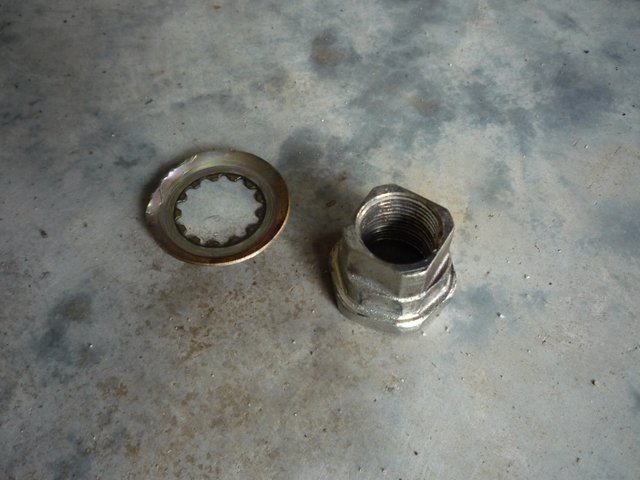
The locking washer and the stubborn nut, free at last: 

Whew!  I had had visions of having to take the bike to a shop just to get that nut loose...and the mechanic taunting me like I am a 98-pound weakling for not being able to get it off. 

I thank my wife for her help with a smooch and a hug (I hope I am not too greasy), then get back to the task at hand.  I loosen the rear wheel to put some slack in the chain, and the front sprocket comes off easily. 

There is a large amount of accumulated chain lube around the sprocket, so I clean that out. 

I remove the rear wheel, and use the impact tool and the appropriate impact socket to remove the six sprocket retaining nuts.  A little cleaning up of chain lube from around that area, and I am ready to start reassembly. 

I carefully examine the service manual for the correct torques, and get out my trusty torque wrench. 

The rear sprocket goes on easily.  I apply molybdenum disulfide/oil assembly lube to the new front sprocket splines and to the face of the nut, then loop the chain around and install the sprocket and washer.  I snug the nut, but I have to wait for the rear wheel and chain to be installed before I can torque it because I need the rear brake applied to keep the shaft from rotating as before.  (For that, I have to go get my wife again.) 

I position the chain around the rear sprocket, and reinstall the rear wheel.  I tension the chain by tightening the nuts on the two tension studs, making sure the alignment markings display the same, side to side. 

I tighten the rear axle nut and recheck the chain tension, because sometimes tightening the axle causes the chain tension to change a bit.  It hasn't this time. 

I also remember to check the chain tension at its tightest point.  You do this by rotating the rear wheel and feeling when the chain has the least amount of droop on the bottom, or return, side.  If you don't do this, there is a chance that the chain will be too tight when the suspension is deflected while riding.  This could cause expensive damage to the countershaft and its bearings. 

I call for my wife to come out again.  She drops what she is doing, and appears, wondering how long it is going to take this time.  I assure her that this will only be a short tenure this time (I hope).  She holds the brake pedal as I tighten the countershaft nut to the 95 ft-lb spec.  I use the impact socket on the torque wrench for the same reason as when removing the nut -- to keep from rounding off the corners of the nut. 

I again check chain tension and everything is good.  I bend over the edge of the countershaft lock washer so it is against a flat on the nut.  Don't want that coming off, now do we. 

Everything looks OK, so I put the RPM sensor and the front sprocket cover back on.  I install the cotter pin in the rear axle nut, and tighten the chain tension stud jamb nuts.

An application of lube to the chain is next.  
I slip a sheet of corrugated behind the chain to keep from squirting the tire.  I'd rather not see what the effect of that might be. 

Ready for a test ride. 

I suit up, and take it for a little spin.  I try some quick accelerations and pay attention to the feel, and whether the problem still exists.  The unevenness is greatly reduced. 

I think this may have fixed it.  The only thing better would be to have replaced the chain again, but I am not made of money, so that will have to wait a while.  

Lesson learned: At least replace the front sprocket when replacing the chain.  Here is a picture of the old next to the new front sprocket.
What do you think?  Was it time for a replacement? 


Resource to help investigate final drive sprocket ratio changes: Gearing Commander
.
.

.

Tuesday, August 20, 2013

Toccoa Territory


.
Normally, this is a good time of year to go up into the mountains along the Blue Ridge Escarpment, but it has been raining a lot and I didn't think it would be enjoyable or especially safe to navigate the twisty roads with all of the potential hazards they might contain

So I took a really easy route to a place I have been before to view some new-to-me sights.  

I have been to Toccoa Georgia three times before, and there are a lot of neat things to visit there, including a mountain that I climbed, and some military history, and a large railroad trestle, and a pretty waterfall.

This time around, I take a route to get there that I have not been on before.  Still not really exciting, but different. 

Almost into Georgia, but on the east side of the river that separates it from South Carolina, I have to cross the railroad tracks.  When I get to that point, I find this underpass.
One lane.  Have to be careful here. 

A little further on, I run across a lonely church building.  There is no sign identifying it on the road, and the parking lot is empty.  I stop to see it.

The sign by the door says it is St. John's Anglican Chapel.
It looks old, but there is a new foundation under parts of it, and a lot of the exterior has been stuccoed over. 

I see another door around to the side, so I take a picture through the glass.
It is clean, orderly, and well kept inside.  I wonder when it is used. 

I notice a small outbuilding near the back.
I think I could use that about now.

Alas, it is not to be.
Locked out! 

They apparently have running water inside, though.  Clever -- and high-tech -- setup, indeed.

I make other arrangements and head on my way to see some other new stuff. 

Just into Toccoa I spot a gift shop with a large painted rock in front of it.  I stop and go in to see about the rock.  The Dream Givers Art Gallery is run by a friendly woman, Dianne Lawson, and sells all manner of knicknacks, jewelry, artwork, and other neat things all made within about a 60-mile radius of Toccoa.  The shop is located in an inviting 1930's bungalow with plenty of hardwood floors, and craftsman-style details. 

I look over the wares, but I am more interested in the big rock outside, so I ask her why it is there. That is a bit of an odd question, and she pauses a second before answering. She says it is important to her that people not forget about our American heritage and history, especially the sacrifices made by our uniformed military servicemen for our freedom.


I can't agree more, as evidenced by some of my previous posts on this blog:

Motorcycles and Freedom
Memorial Day
Thanksgiving Day
Freedom is Never Free! -- Rally to Ridgecrest, 2011

The painting on the rock includes an eagle and some parachutists. These are references to the Screaming Eagles, the 506th Parachute Infantry Regiment trained at Camp Toccoa. (The mascot of Toccoa Falls College is also an eagle.)

The rock has the words to the first verse of the patriotic song "America the Beautiful," by Katharine Bates. The words of that song are worth reviewing. Not many people know them today. I have put into bold typeface some particularly significant thoughts, important in 1913 when they were written, as they are now.

O beautiful for spacious skies,
For amber waves of grain,
For purple mountain majesties
Above the fruited plain!
America! America!
God shed his grace on thee

And crown thy good with brotherhood
From sea to shining sea!

O beautiful for pilgrim feet

Whose stern impassioned stress
A thoroughfare of freedom beat
Across the wilderness!
America! America!
God mend thine every flaw,
Confirm thy soul in self-control,
Thy liberty in law!


O beautiful for heroes proved

In liberating strife.
Who more than self their country loved
And mercy more than life!

America! America!
May God thy gold refine
Till all success be nobleness

And every gain divine!

O beautiful for patriot dream

That sees beyond the years
Thine alabaster cities gleam
Undimmed by human tears!
America! America!
God shed his grace on thee
And crown thy good with brotherhood
From sea to shining sea!

O beautiful for halcyon skies,

For amber waves of grain,
For purple mountain majesties
Above the enameled plain!
America! America!
God shed his grace on thee
Till souls wax fair as earth and air
And music-hearted sea!

O beautiful for pilgrims feet,

Whose stem impassioned stress
A thoroughfare for freedom beat
Across the wilderness!
America! America!
God shed his grace on thee
Till paths be wrought through
wilds of thought
By pilgrim foot and knee!

O beautiful for glory-tale

Of liberating strife
When once and twice,
for man's avail
Men lavished precious life!
America! America!
God shed his grace on thee
Till selfish gain no longer stain
The banner of the free!

O beautiful for patriot dream

That sees beyond the years
Thine alabaster cities gleam
Undimmed by human tears!
America! America!
God shed his grace on thee
Till nobler men keep once again
Thy whiter jubilee!
Patriotic, yes, but filled with references to God who has blessed this land beyond measure.

Ms. Lawson asks me about my background.  I tell her that I am an engineer by training.  She says she has been married to one for a lot of years, and she understands.  She emphasizes peculiarly the word "understands."   [Hmmmm.  I wonder what she mans by that.  I have always thought of myself as perfectly normal, and it is the rest of the world of non-engineers who are a little "off."  I may have to think about this some more.]

After I leave the gift shop, I continue on to the Trestle Falls subdivision (at Pushpin B on the map that opens in this link) where there is an overlook (at Pushpin C) for the North Broad Trestle, also known as the Wells Viaduct.  The same tracks that go over that underpass I saw earlier go over this trestle.  I set up my camera on a tripod and wait for a train to pass over it.  A few minutes go by, but do not hear any trains approaching.  Disappointing, so I put on my helmet and gloves to head on my way to find something else new.  

I have recently read a book called R.G. LeTourneau: Mover of Men and Mountains.  It is an autobiography written by a fellow who had grand thoughts about large machinery, including earthmoving equipment and offshore drilling platforms.  He went broke several times in his lifetime, but became very successful later on.  He was a man who was shy and backward in public, but he was quite a devout Christian, and overcame his lack of self confidence to become an inspirational speaker across the country and around the world.  

In the middle of his life, he made the decision to give 90% of his income and 90% of his company's profits to God for His use.  Remember that the Bible requires us to tithe 10% of our income.  This guy tithed 10% and gave a further offering of 80%!  People ridiculed him, said he was odd doing anything like that, and would never make a go of it financially.  Nevertheless, Mr. LeTourneau received spiritual and physical rewards of many times the amount he gave during his lifetime.  

By the way, you don't give to get from God or from others, because sometimes it doesn't work out like that during our earthly lives.  We will certainly be rewarded for storing up treasure in heaven, though. 

Mr. LeTourneau, who lived between 1888 and 1969, was at one point a motorcycle rider, mostly because he could not afford a motor car.  That was back in the early days of motorcycle design.  He learned how to take the bike apart and managed to get it back together a number of times, and it provided a practical schooling in mechanics that helped with his success later on.  

He received more than 300 patents in his lifetime.  His company pioneered electric motor power of large equipment, including wheel drives that eliminated all mechanical connection to the prime mover.  He strived for larger and larger capacity and capability in his machines, recognizing that the more work a man could do with the help of machines, the higher the standard of living would be for all.  His company was the first to use rubber tires for off-road heavy equipment use. 

LeTourneau equipment enabled the Allied forces to build and repair roads and airstrips rapidly, giving Allied forces an advantage that shortened World War II. 

There are several books available describing his company's equipment:
Mr. LeTourneau established technical education courses for his workers, to help them better themselves and thus become more valuable to the company.  He later learned of the Toccoa Falls Institute, later Toccoa Falls College, a Christian school where young people could study and work at the same time to help pay for their schooling.  He was impressed by the character of the students from there, so he decided to build a manufacturing plant in Toccoa. 


At that time, Toccoa was a back woods place with no industry, no skilled labor, no church buildings, no dairies, hardly anything.  His business advisors said he was crazy, wanting to build a facility there; that the effort would be too costly to pay off.  Not deterred, he brought in skilled laborers from his other plants to build a new one, built housing for workers, added churches, shops, and other infrastructure
 

In fact, he invented steel prefabricated houses, and later concrete houses cast complete "as though laid by a giant hen," according to his book.   


What a benefit and blessing it was to a community when a modern industry brings these things in!  Their entire standard of living increased dramatically.  

The manufacturing plant he erected in Toccoa was the first manufacturing plant built from prefabricated sheet metal panels.  This technique is one based on one of Mr. LeTourneau's many patents, and allowed large buildings to be constructed without major structural steel.  

The steel panels are built like this, taken from that patent:  
I go looking for some of these buildings, and come across the "Famous LeTourneau Hanger" at Toccoa Airport, known as LeTourneau Field


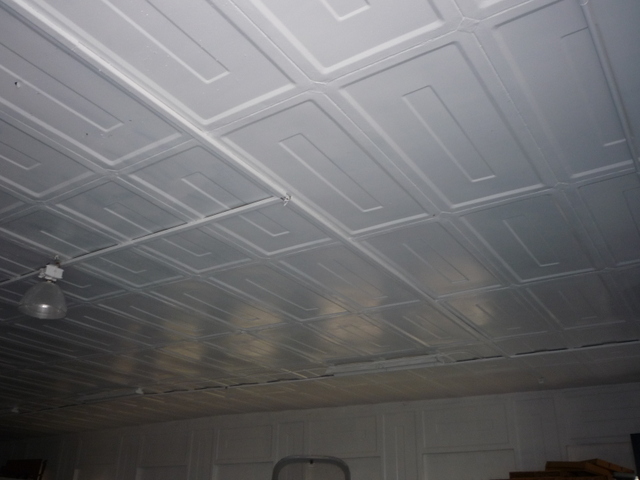
This building is constructed entirely using the prefabricated insulated steel panels, and each seam is fully welded, making a sound structure.  Here is a photo of the wall panels, with a sliding door to the right, built the same way.
An interior view:

The airplane hanger is currently occupied by Corben Sport Planes/Ace Aircraft Company.  They make kits for homebuilt small aircraft called the Baby Ace and Junior Ace.  
I boldly venture into the hanger and into a lighted office in the back.  There I find the current owner of Corben, Mr. Bill Wood and his wife Veda.  I think they are a bit surprised to see me in my riding suit, helmet in hand, but they quickly warm up as I ask them a few questions about the hanger and about their business. 

The plane designs go back to the 1920s.  Mr. Wood bought the company in 1998, and runs not only the homebuilt (actually better referred to as experimental) plane business, but also Foothills Aviation, for the sale of avionics equipment, maintenance, structural modifications, and inspection services. 

Mrs. Wood insists that I look at a few videos on her computer, but surprisingly, not any showing their airplanes.  She wants me to see the short takeoff and landing (STOL) experimental light plane manufactured by Just Aircraft, located about half way between here and home, in Walhalla South Carolina.  (I have yet to visit there, but it is on my list of things to do.

They tell me about the airfield, created by Mr. LeTourneau so he wouldn't have to land his plane on the road -- and for the good of the community.  Two large hills were leveled to make the area flat enough for the runway. 

I ask to snap Mr. and Mrs. Wood's picture, and they move closer to one another for the shot. 

Do you notice in the background those skinny drawers to the left of Mr. Wood in the picture?  Do you young whippersnapper engineers know what’s in them?  I’ll bet not. 

The large, flat drawers are used to store engineering drawings, something not many newly-minted engineers know about, what with CAD systems and the wide-format printers of today.  Back then, the original was drawn with pencil, or sometimes with ink on thin, high-quality paper called vellum, or with “plastic” lead on almost-clear polyester film often known by one of its trade names, Mylar. 
 
Then, a blueline machine (or in even older days, a blueprint machine) was used to shine light through the drawing and onto a sensitized roll of paper whose image was developed by ammonia fumes.  Cleans your sinuses while you wait!  Now you know.

The Woods are gracious hosts and bid me farewell, inviting me to return at any time.

I take a shot of one of the many planes on the way out of the hanger. 
Neat experience.

The trip home is along US-123, a good road, but not very interesting.  It is quick to use, though, to get back.

Only 176 miles today along this route, but it has been an interesting day of discovery. 
.
.