Showing posts with label hobby. Show all posts

Monday, June 25, 2018

No Drone Zone at Caesars Head

.
I rode up to Caesars Head a few weeks ago.


Caesars Head is a South Carolina State Park, 26 miles from home, and it is fairly easy to get to.  The twisty road that goes up the Blue Ridge Escarpment to the park is only about eight miles long, and is in fairly good condition in most places.  The twisty part of the road is not nearly as long as on the nearby US-178, but there are several tight turns along the way. 

Caesars Head

Twisty part of US-178


The reason I went to Caesars Head was that it was an easy addition to a route that I rode called A Two Hour Afternoon's Jaunt that had appeared in an issue of the old and gone Motorcycle Lifestyle Magazine. 

Anyway, the overlook at Caesars Head (that is correct; there is not an apostrophe in Caesars) is usually a good place to see the mountainous countryside from a birds-eye vantage point.  That photograph at the top of the post gives you an idea. 

Pretty country, yes?  Here is a slightly different angle:


You can see the back side of Table Rock Mountain, with Table Rock Reservoir this side of it.  This overlook is really the only place you can see into the distance from Caesars Head Park, and the overlook is very close to where you can park your bike.

As I was parking that day, I noticed something new.  


Did you spot it?  Here is a closer view:


Now do you see?

It says I can't fly my drone here any more.  (Not that I have one.)  It is mounted on a very substantial post. 

That's unfortunate, because I like to see videos of places like this taken from a drone.  Some of the drone pilots are quite good at getting the right views and motion, and their editing can be very effective in enhancing their work.

Like these: 
There are some large houses adjacent to the park, and I suppose some of those residents could have been buzzed by some irresponsible pilot.  If that is the case, there are probably civil actions that could be taken against the pilot, instead of banning drones entirely. 

I did a little research and found that drones are outlawed in all national parks.  Citing safety and noise issues, drones are banned until the National Park Service comes up with a long-term policy.  [I wonder how long that could take.]  The ban covers not only the 59 full-fledged national parks but about 350 national monuments, seashores and other sites run by the NPS, about 84 million acres in all.

That is a lot of territory now off limits. 

Seems like our freedom is again under attack here.

Oh, by the way, the ban carries a maximum penalty of a $5,000 fine and six months in jail!

Try this website called Know Before You Fly to learn some of the rules.   


For recreational use, you can fly under the Special Rule for Model Aircraft:
  • Fly for hobby or recreation ONLY
  • Register your model aircraft
  • Fly within visual line-of-sight
  • Follow community-based safety guidelines and fly within the programming of a nationwide community-based organization
  • Fly a drone under 55 lbs. unless certified by a community-based organization
  • Never fly near other aircraft
  • Notify the airport and air traffic control tower prior to flying within 5 miles of an airport*
  • Never fly near emergency response efforts
Or, you can get a Remote Pilot Certification (14 CFR part 107).  For that, you must:
  • Be at least 16 years old
  • Pass an aeronautical knowledge test at an FAA-approved knowledge testing center
  • Undergo Transportation Safety Administration (TSA) security screening
  • Register your aircraft with the FAA
Part 107 Operating Rules:
  • Unmanned aircraft must weigh less than 55 pounds, including payload, at takeoff
  • Fly in Class G airspace
  • Keep the unmanned aircraft within visual line-of-sight
  • Fly at or below 400 feet
  • Fly during daylight or civil twilight
  • Fly at or under 100 mph
  • Yield right of way to manned aircraft
  • Do not fly directly over people
  • Do not fly from a moving vehicle, unless in a sparsely populated area
If you fly for commercial purposes, then the rules are different.


Whew.  That is a lot of hoops to jump through just to fly a little airplane.  I think that the regulations include all of the model planes that many of us flew when we were kids (and now, sometimes as adults, too, like I saw back in 2014).  

As I said, I think our freedoms are being encroached upon. 

For state regulations, you can look here or here, but know that these websites may not be completely up to date.

Local municipalities may also have rules and regulations, so you will have to contact them to find out what they require.


Anyhow, our freedom to do almost anything is getting cut more and more these days.  So, fly 'em while ya' can.  (But not at Caesars Head.) 

Fortunately, the park is still a nice place to go to look at God's creation. 
.
.
.

Monday, September 25, 2017

Where 'Ya Been, Bucky?

.
I haven't posted since July, so you might wonder what's happened to ol' Bucky.

Well, I'm just busy with other stuff lately, so I haven't written much here.

[What kind of stuff, Bucky?]

Well, way back in 1979, my father-in-law bought a new car.  It was an Oldsmobile Delta 88 Royale.  He kept it nicely, and when he wanted to get another new car, he sold it to us.

We still have it.


It has been in the garage since March of 1989 when we got it from him, and have only driven a relatively few miles in the succeeding 28½ years.

It has a 4.9 liter (301 in3) V-8 manufactured by Pontiac.  That year was just after the dust up and lawsuits that ensued when owners who thought they were getting "Rocket Oldsmobile" engines were actually getting engines made by other GM divisions.  This Pontiac engine has a Dualjet two-barrel carburetor made by Rochester.


Options include air conditioning, analog gage package instead of idiot lights, AM/FM stereo radio, cruse control, power door locks, and driver reminder package.


The red velour seats and the carpet are very nice, and quite comfortable.  The power steering provides effortless, one-finger steering, even when parking.  I like that a lot.  It is not like the heavy labor you have to exert with today's barely-there power steering. 

A trailer hitch, auxiliary transmission cooler, power CB/radio antenna, and curb finders were added over the years.  What are curb finders, you ask?  Well, they extend from the body in front of the right front wheel and behind the right rear wheel, and telegraph noise to the driver when parking that he is getting close to hitting the curb with the tires.


They work like a charm, and save the white sidewall tires from a lot of scuffing. You can still buy them. 

Everything on the car was original except the alternator, water pump, horns, master cylinder, ignition lock cylinder, headliner, battery, hoses, tires, speedometer cable, and maintenance items. That's doing pretty well for such an old car, I think. 

I decided to get the car out a few months ago because the garage I was keeping it in was no longer available.

...and I learned something when I got it out of there: Things don't work well on a car if you don't drive it regularly. 

So, I put my mechanic's hat on and set to work.

After so many years unused, it needed rear brake cylinders.  Both were seized in their bores, and would not actuate the drum brake shoes.  While I had it apart, I replaced the shoes and the various hardware that holds the pieces together on the brake back plate.  Not too bad a job, really.  The front disk brakes were OK. 

Next I tried to start the engine.  No go.  Cranked fine, but would not start.  I checked that there was gas, broke the fuel line and it spurted out as it should.  The gage showed full.  I checked for spark.  OK.  I checked for compression, and found it to be to specification, and nearly equal on all cylinders.  Good.  I rebuilt the carburetor, cleaned the EGR passages as long as I was in there, replaced the fuel pump, and changed the fuel filters.  (The original in the carburetor inlet and one I added in the line between the fuel tank and fuel pump.) 

Where'd the carb go?
Before rebuild.
Before rebuild.
The carb rebuild kit is a very nice one I bought from QuadrajetParts.com.  I bought some extra fuel bowl gaskets because that gasket can get ripped a little every time you open the carb.  (I opened it a few extra times while I was troubleshooting the no-start issue.) 
 
EGR passages beneath EGR valve.

Rebuilt.
By the way, both QuadraJet Parts and The Carburetor Shop have good online troubleshooting sections.

Alas, the engine still would not run well.  Rats.  Now what? 

I put in more time with the thinking cap on. 

By using my little remote video camera inserted through the filler pipe, I found that the fuel tank was pretty corroded inside, and I found that the tank was nearly empty instead of nearly full as the dash gage had indicated.  I figured that by the time I cleaned the old tank and coated the inside, I could replace it with a new one from Advance Auto Parts.  It turned out that the fuel gage sending unit was corroded too, causing the needle to show that the tank was full.  So I replaced the fuel tank and sending unit, the latter including the fuel pickup and return, and the sock filter.


Are you old enough to remember that the fuel filler pipe is behind the rear license plate on these cars?

I also checked for the integrity and correct routing of all vacuum lines using this diagram.


To be sure everything was ready to make the car drivable, I also replaced the spark plugs, distributor cap and rotor, and spark plug cables.  Despite the air conditioning compressor and evaporator housing positioned above and near the right bank of cylinders, the spark plugs are easy to reach and change.  That's good! 

After all that, and a tank fill up of fresh non-ethanol fuel.  It started and I went to adjusting the idle mixture and RPM with this tool from Advance Auto Parts, .AutoCraft AC667.


I had not rebuilt an automotive carburetor for more than twenty years, so I had to be careful to relearn my skills there.  For that matter, I have not driven a car with a carburetor since this one went into storage.  After all that work, the engine now starts and runs well.  Whew.  Looking back, I can now see that the real problem with the engine not starting and running well was probably decade-old, sour gasoline in the tank.  If I had drained that, I might have gotten by with a lot less work, but changing everything that I did resulted in a reliable, clean fuel system, and other well-functioning engine systems as well. 

To finish it off, I flushed and refilled the cooling system, changed the oil and filter, replaced the battery, and put on a set of new whitewall tires. It is getting difficult to find whitewall tires now, as many cars don't come with them any more.  I think they look good on older cars like this one, so I had to find them.  WalMart to the rescue with Hankook Optimo H724.   They seem to ride and handle nicely.  The tire jockey at WalMart noticed that the right side of the car sits slightly lower than the left due to age.  He therefore deduced that the shock absorbers were bad.  That shows that even someone who works with cars every day has no idea about the function of the vehicle's springs vs. its shock absorbers.  Sad. 

Now some lipstick and powder for this old girl. 

The body side moldings were yellowed and coming loose, so I bought a new set from ebay seller automotiveauthority, cut them to fit properly, and put them on.  The moldings come with sharply tapered ends on front and rear, but those ends do not look anything like the originals on the car.  

Ugh.  Ends not at all like the originals.
I cut and glued the proper end configurations, using 3M Plastic and Emblem Adhesive, so they look right.  I took a lot of pain to get them positioned in the correct place and on straight.  I used an aluminum straightedge I bought at WalMart and stuck a self-adhesive magnetic strip to the back to help keep the moldings straight and lined up from one panel to the next. 

Configuring the ends to look like the originals:  

Front

Rear

I put clear nail polish on the cut ends as instructed by the seller so the thin chrome film won't peel off.   


The front and rear ends of the moldings are made like the originals and look quite similar.

The rear bumper fillers were originally made of a flexible material that was turning yellow and literally falling to pieces.


I bought a new set from ebay seller vpexpressparts and finished them with primer, color coat, and clear coat purchased from Automotive Touchup. 


They came out very nice.  The new pieces are harder plastic than the originals, but with some trimming and filing, they fit pretty well.  The color matched well, and the aerosol paints seem to be top notch.

The trunk mat is original and like new, and the spare tire, jack, and hold down hardware are as they were when new.


The spare wheel cover is one I picked up many years ago just for this car.

Now I have a 38-year old car that looks very nice.  It has only about 86,000 miles on it, and runs well, drives well, and stops straight. It is surprisingly peppy for the engine size*, curb weight**, and carburetor type.  The body has never been damaged, it has the original paint except for the bumper fillers, the engine has never been touched internally, it doesn't burn oil, and the air conditioning works. I have the original Owner's Manual and other literature, as well as a Service Manual. 

I splurged a bit and bought a "1979" license plate for the front from ebay seller theoldcarlover.   He sells them with any year you want. 

See what you think of my "new" car.


I have driven it a bit, but still don't have a garage for it.  Reluctantly, I have it up for sale. 

Wanna buy it?  SOLD!

Next time, I'll write about motorcycling.  I promise.

------------------------------------------------------------------------------------


*     140 Hp at 3600 RPM, 235 ft lb torque at 2000 RPM, 4" bore x 3" stroke, 8.2:1 compression ratio.
**   ~3583 lb.  
.
.
.

Saturday, March 29, 2014

Big Boys' Other Toys


.
Most who read this blog are probably interested in -- let me guess -- motorcycles.  Me, too.  But, did you know that some big boys like other kinds of toys? 

Hard to believe, I know, but there are some who are not interested in motorcycles, but have picked another kind of toy to play with.  I even found that some of these miscreants are not satisfied with just one type of toy, but rather, enjoy more than one type. 

Imagine that!  

Well, I recently explored two other types of big boy toys.  I witnessed first hand the affliction of some very big, ol' boys playing with toy trains and toy airplanes.  (Unlike he-men who ride motorcycles, which are certainly not toys like those others.  Right?) 

[Oh, yea, right, Bucky.] 

I ventured out to visit the Central Railway Model and Historical Association, located in Central South Carolina.  The little town of Central houses only about 5000 souls, but is close to both Clemson and Southern Wesleyan Universities, there are many students nearby during the school year.  Central was not named because it is near the center of our state, but rather because its geographic location is about half way between Atlanta and Charlotte, along the former Atlanta and Richmond Air-Line Railway line.  

The railroad still runs through Central, though the name has changed to the Norfolk Southern.  I happened to roll into town just as an intermodal train was passing through.  That train had previously crossed over a quite significant trestle near Toccoa Georgia that I have visited on some other rides -- 1, 2 and 3.    

I enjoy watching trains, so I hopped off the bike and ran across the street so I could get its picture.

In the process, I happened to capture myself on my video camera.  Pretty humorous, watching me dodge traffic and dart back and forth trying to get a good angle for the picture [of the train, of the train, guys].

After the train passed, I went around the block to the model railroad's building. It is in a house they have fixed up for the various layouts.  I have visited here before, in October of 2010, so we will be able to see the progress they have made in their layouts and scenery. 

I park out front, and spot this Pontiac Solstice that looks almost new.  ...and the color is nice I think.  Somebody around here must own this toy.  I have always liked the design of that little car, built between 2006 and 2009, but the recession, the government takeover of GM, and the subsequent demise of the Pontiac badge killed it.  Only 66,000 were built.

I go into the building and am greeted by some older fellows who welcome me, and ask what I was riding.  Hmmmmm.  I don't know why people ask me that all the time.  I tell them about my Ninja, then stow my helmet out of the way under a bench, and begin to look around.  They have made considerable progress on the layouts since the last time I was here, and there are probably eight or so guys working on the scenery, the rolling stock, and the electrical system, and two or three who are running the trains with handheld throttle controls.  Model railroading has certainly come a long way since my Lionel O gage days, about a hundred years ago, I think it was. 

Most of the layout is HO gage, with some HO N-3 narrow gage in places. 

Here is a turntable, but there is no roundhouse near it for some reason.  Maybe is it just for turning locomotives around. 

This fine establishment is the Suds Bucket Bar, where a biker is in the process of being thrown through the front window from inside, but I am not sure that they haven't mixed their metaphors, here.  The bikes outside are multi-colored, but certainly not sportbikes.  Maybe they represent some of the earlier standards that were painted various colors, like some of the ones I saw at the Wheels Through Time Museum in Maggie Valley North Carolina.  Anyway, serious motorcycle riders wouldn't do that kind of thing, let alone drink and ride, I hope. 

The Abattoir of Seneca, SC.   (I'm sure you know what that is, right?) 
 Inside detail:

Some parts of the layout are not completely sceniced as yet.  Like here:

A massive derailment caused by a car wheel catching a switch point, making the trailing cars derail.  If I had been a few minutes earlier, I would have had exclusive footage for the 6:00 News! 

Passenger cars and a station:

A rock quarry and processing building:

Paper mill (though there were never any real paper mills near here):

The American Flyer S-gage layout, and its overseer, are tucked away in a room of their own: 
I always wanted an S gage train set like that.  It ran on more realistic two-rail track, and the rolling stock looks more like the real thing.  Mom and Dad just couldn't swing it, though, after having funded the Lionel.  Maybe that is why these boys like playing with trains so much. They are trying to relive their childhood, or, perhaps, they want to introduce a new generation to the hobby.  Either way, that's good. 

The modeling scales, from G (I think, the largest here, at the rear) through Z (the smallest). 


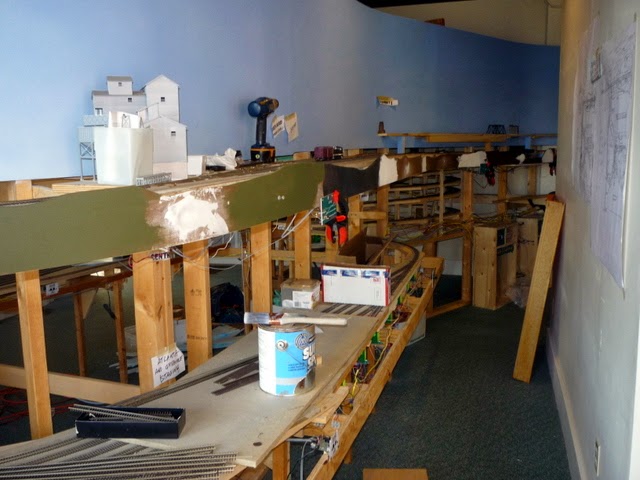
At my last visit, most of the scenery looked more like this:


An important note to the modelers back then:

Lots of work has been done by these devoted boys playing with their building full of toys. 


I complete my gawking at the little railroad, and head to my next point of interest on the ride plan.  I have programmed my GPS to lead me there, so all I have to do is follow its spoken and on-screen instructions. 

I do so, and it leads me to a locked gate at the Black Sheep RC Club.  I am surprised that no one is here on a pretty Saturday. 

The day is not lost, however, because I have another point of interest programmed in, too, and it only takes me about five minutes to get there.  It is the Firetower Flyers RC Club.  Their flying field is adjacent to an old fire tower, and their slogan is "Where the Pilot Always Walks Away!"  Apt, I think.

The fire tower: 

A sign on the side of the building. 

The Hobby Connection, in Easley where I live, is a very nice store selling all kinds of hobby supplies, including trains and planes, helicopters, cars, and assorted other stuff.  You can spend hours in there.  They also have an outdoor oval racetrack, a road-race course, and a dirt course for RC cars and trucks.  You can see the courses from the viewpoint of a satellite here. 

As I park at the Firetower field, I have already spotted several guys with mostly large model airplanes, working on them on the field or on benches. 

As I dismount and take off my helmet, three or four of them walk over and begin to ask questions about my bike.  How fast will it go?  How old is it?  How many ccs?  How long have you been riding?  What does this thing do?  What does that thing do? 

A few of the guys make statements like "I'm glad to see you dressed properly to ride a motorcycle."  Yes, so am I, I tell them, reflecting that I have never and would never wear any less to ride.  They nod their heads in agreement.  Another continues, "I wish I could ride something like that.", and, best of all, "I wish my wife would let me ride something like that."

I carefully construct a response to that last statement to encourage them to go ahead and do it, but that wouldn't get me into too much hot water with their wives -- who, unlikely as it may seem, could be lurking on this blog. 

[Don't come after me, ladies.  I did the best I could with my wording.  Big boys do need toys, you know, and some of them need lots of toys.]

As the questions and comments subside, I walk out to the field where one of the pilots is warming up his plane.  None of the planes flying today is equipped with the little Cox .049 cubic inch glow plug engine my Baby Ringmaster control-line airplane has.  Rather, these are running 2-stroke cycle engines with as much as 50cc (3 cubic inch) displacement.  Some small motorcycles have the same size engine!  The fellows tell me that a few planes that fly here have as much as 100cc displacement. 

Here is one of the planes, in the process of being started by a swing of the prop. He had to give it several swipes before it fired off. 
Those posts in front of the wings keep the plane from taking off on its own -- which would not be a good thing.  Note the smaller plane coming in for a landing in the upper right of the photo. 

Fueling up.  His fuel supply tank has a hand-cranked pump, but some others have electric pumps -- the height of luxury. 

Electric power! 
Its performance was quite impressive, and it flies for more than ten minutes on one charge.  That doesn't seem like very long, but a flight of that length is enough to get the heart pumping with high-speed aerial thrills. The battery types that make electric model planes possible are described here. 

Flying on the level.
The fire tower is about a quarter mile away. 

Dragging it back after a safe landing: 

The pilots are pretty skillful, performing spins, stalls, inverted loops, rolls, etc.  As you can tell, I had trouble catching them on my camera. 

Chewing the fat.

Some of these men have quite an investment in their hobby.

After an hour of craning my neck at all angles to watch these birds in flight, I bid farewell to this group of big boys, and head on my way.  I have certainly enjoyed seeing some of their toys today.

By the way, I still have that Baby Ringmaster.
And you can still buy one from Brodak in Carmichaels Pennsylvania. 

Mine is covered with tissue paper painted with dope (a type of lacquer) to shrink it and to provide color.  The can in the lower left is the dope.  The can in the upper left is fuel.  The engine is laying beside the tail.  I have not flown the plane in many years, but it certainly could fly.  Maybe I will fix it up this summer and give it a try. 

Here is a larger version of the Ringmaster being flown.  It is possible to do several aerobatic tricks despite the limited control using only the elevator.


Well, my riding/visiting-boys'-toys day is complete.  I have ridden about 71 miles, including a detour up to SC-11 before going to Central.

What are your other big boy toys?  


Related Posts:

Apple Valley Model Railroad Club, Hendersonville, NC.
.
.