.
A few days ago, I posted about my visit to the
Pisgah Astronomical Research Institute [PARI] north of here. This is some more information about that trip.
The PARI tour for the general public is every Wednesday at 2:00 PM. I took the day off and started out earlier than I needed to, so I had some time to kill -- riding, of course!
View Larger Map
I enjoy going north on SC-135, so I start out that way. I turn right on SC-186, ride through Dacusville, then US-276 to Marietta, and Cleveland, SC. I turn left on SC-11 and ride to a side road whose name catches my eye: "
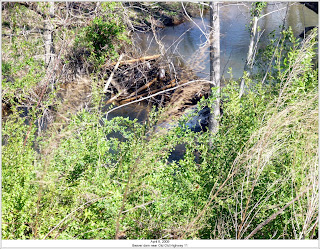
OLD OLD HWY 11." Hmmm. It must be really, really old! Rather, I think the meaning is that Highway 11 has been relocated twice, resulting in Old Hwy 11 becoming Old Old Hwy 11. I'll have to do some research on this. There are the remains of a building on the corner, evidenced only by a standing chimney with a first floor and a second floor fireplace opening. There is also a stream across the road with a beaver dam visible from the road.


A little further on, I come to
Wildcat Branch falls. You don't even have to dismount to see the lower falls. All you have to do is stop and look. The name of the falls is not marked, but there is a wide paved parking area on the north side of the road.
View Larger Map
There is also an upper falls that is a short walk up the hill and the remains -- only the fireplace and chimney -- of a cabin that once was there.

While I am stopped, I can see Table Rock, so I take its portrait.

And a closer up view.

After a few minutes, I continue on a few more miles to the Table Rock visitor center, a favorite place to stop and rest, hydrate, and see the scenery. Recall that the view of Table Rock is very good from this vantage point, as is Lake Oolenoy. The ranger there also points out Pinnacle Mountain to me, the highest peak entirely within South Carolina.


There is a higher peak, Sassafras Mountain not far away, but part of it is in North Carolina.
Some low-growing flowers in bloom.

Azalea.

Tulips.

All right, all right, cut the comments about the softer side of Bucky. You have to agree that the flowers are pretty to look at.
Once I leave Table Rock, I go further along SC-11 to the Holly Springs Store. I usually stop there to see if there are other bikers about. Today there are two. Tim, riding a vintage Honda V-twin, and one other fellow.

I chat with Tim a bit about his bike. He says the bike was in good original condition, but he has done considerable cosmetic work, and some mechanical work to get it into the fine shape it is. The only thing that he says had been repainted is the fuel tank. He speaks proudly about how well it came out and his joy in riding it now that it looks and runs almost like new. Good work, Tim.
Tim is on his way to a family gathering, so he doesn't have an answer to my query about the road condition into the mountains on US-178. Neither does the other rider who is having breakfast. Oh well, I'll just have to find out for myself whether there is any sand or washed gravel on the road.
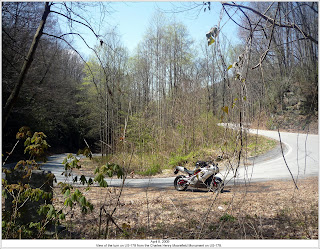
It turns out that there is neither. I take it easy, though nonetheless. I don't want to wreck. One of the particularly tight turns just before entering North Carolina has a stone monument to Charles Henry Moorefield, a South Carolina state highway engineer between 1920 and 1935, who probably had a part in designing this road. It must certainly have been a task. Look again at a closeup of the route up the Blue Ridge Escarpment.
View Larger Map

I reach Rosman, NC and stop for a drink of water and to rest for a few minutes. PARI is only a few more miles, so I have a little extra time.
Once rested, I continue to US-64, turn left, then turn right on NC-215 where
Headwaters Outfitters is located. They do canoe, kayak, and tubing trips on the French Broad River and have a store here.
NC-215 is the route that also goes up to meet the
Blue Ridge Parkway about fifteen miles north of US-64, a great place to ride that I will report on in future. Today, however, I am going just six miles to a side road called Macedonia Church Road. The driveway for PARI is off this road.

I stop at the entrance and take note of this sign.

I ponder it for a minute, but conclude that I must have missed my engraved invitation in the mail. Actually, their Wednesday tours are well-publicized on the Internet. I go past both the sign and an unmanned guardhouse. A sign at the guardhouse says to park by the flagpole. I wander along for a few hundred yards gawking at the two huge telescope dishes and the many buildings before I find the flagpole. It is better that I look around while on foot: It is too easy to steer off the road when on the bike with such interesting stuff around. I park, take off my gloves and helmet, pull off my tank bag, set my alarm, and go in.

A young astronomer near the entrance.

They charge a whopping five dollars for a tour. I open my wallet to retrieve some cash. By the way, my "wallet" is a zip-lock bag that I use to keep my money and identification in when I ride. That keeps the documents and what little money there is from getting soggy with sweat (sorry to bring it up, but sweat does happen) and from rain.
I take off my jacket, armored shirt, and sweatshirt and stow them with my tank bag near the front desk. I meet a pleasant woman at the desk who, it turns out, will be one of our guides today. The official designation on her badge is docent, which means a "volunteer trained to give educational tours to visitors." I join the small tour group of four others in a multimedia room for an introductory movie. It describes the history and current use of the site. It started out as NASA satellite tracking station, then was used for cold war listening in on overflying spy satellites, and is now used for research and education.
The docents today are Bobbie and John. Bobbie, the woman at the front desk and a former employee of the NASA tracking station in its (and her) earlier days, was later a college science teacher at nearby Brevard College and elsewhere. John is a retired electrical engineer. Both are very knowledgeable and articulate, and were eager to answer our questions.
We are allowed to take pictures of anything we see. It makes me feel like I am a privileged visitor to a secret spy installation. And so I am that -- just a few years too late!
These two small buildings were used for high-level briefings during the satellite monitoring period at PARI. Officials would disembark from their vehicles under the canopy and walk beneath it to the buildings, so spy satellites could not identify them.

PARI is a great place to visit, but an even better place to learn about astronomy, physics, and other disciplines. They offer classes for kindergarten through post-graduate students.
There are many radio telescopes there including two with a dish diameter of twenty-six meters (eighty-five feet).
 Above photo is from the PARI website.
These are not the largest such dishes, but they are quite impressive, especially up close. They can point in any direction down to the horizon of the bowl-shaped PARI site. They were once positioned by hydraulic drives for control and speed. Remember that a satellite directly overhead can have considerable velocity and the dish must keep up with it. Today, the hydraulic drives have been replaced with electric drives. These are suited for the current use of the dishes but are much slower in positioning capability.
There are many more radio and optical telescopes around too, some of which can be controlled and monitored by students over the Internet. The surroundings are also ideal for optical telescope viewing of the Heavens as it is quite far away from artificial lighting sources.
 Above photo is from the PARI website.
 Above photo is from the Wikipedia website.
One educational program for students involves their building a radio receiver -- nicknamed JOVE, a name for Jupitor -- in the 20.1 MHz range that connects to the audio card of a computer to display the received waves, mostly from the planet Jupiter and from the sun.

JOVE receiving antennas: Wire dipoles.

Another project for students is building an optical telescope using an eyepiece and objective lens held in position by sections of PVC pipe. This makes for an inexpensive, but functional and fairly rugged telescope.

We walk through an underground passage that comes out near one of the large dishes. The passage contains all of the control and data cables for the dish. John quips that this is the self-guided portion of the tour -- we couldn't go wrong here anyway, since there is only one way to go.
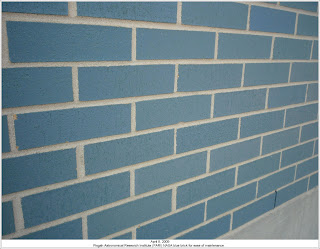
Once we emerge from the tunnel, I ask about the blue glazed brick evident on the exteriors of many of the buildings. John tells us that the brick is NASA blue, and was specified so that the buildings did not have to painted, and did not require periodic maintenance.
Some more information from the PARI website:
"The facility, then called the Rosman Research Station, was a NASA site used during the 1960s and 1970s for tracking manned and unmanned space flights. It was the nation’s primary east coast satellite-tracking facility. In 1981, the facility was transferred to the Department of Defense for use as an intelligence gathering facility for U.S. defense and satellite communications. In 1995, the Department of Defense closed the facility, and turned the site over to the U.S. Forest Service.
"In 1999, the site was purchased from the U.S. Forest Service and given to PARI for use as an astronomical research and educational facility.
"A key man who had the vision to start the institute was J. Donald Cline. He was born in Statesville, NC, and has lived in the state most of his life. He has lived in Greensboro since 1959 when he joined the technical staff of Bell Telephone Laboratories. In 1977, Don left Bell Labs with three other engineers and formed Micro Computer Systems (MCS). Following the sale of MCS to Harris Corporation in 1995, Don served as the president of MCS Operations at Harris for one year.
"In 1998, Don founded the Pisgah Astronomical Research Institute and continues to serve as PARI’s president and board member."
PARI hosts homeschool days, public tours on Wednesday afternoons, and evenings at PARI held once a month to hear about and view the Heavens.


 Above photo is from the PARI website.
PARI is also home to the Astronomical Photographic Data Archive (APDA), a site to help preserve some 80,000 astronomical photographic plates. These glass plates were the primary recording medium for astronomy data from the late 1800s until the 1980s. The plates are being scanned into computer files for more rapid access by astronomers around the world. The scanning is done by a very accurate scanner supported by a large precision granite block. The resolution of the scanner is one micron (0.00004 in). It takes about half a day to scan each plate, and they have great banks of hard disk storage space to hold all the data. This will be quite a job!

The tour ends about 4:00 PM, and I linger for a few minutes on the site looking again at the buildings and equipment. It is certainly an interesting place, especially for someone who is a student of astronomy and science. Already, I would like to come back again.
I put on all my gear, mount my bike, and start out for home. It doesn't seem quite as far on the way back. Maybe I am becoming more confident in my riding. Being mostly downhill on NC-215 and US-178, I use the technique of staying in third or fourth gear to control my speed around the turns. It seems to work fairly well, but I find that I still must tell myself at times -- frequently out loud -- not to let off the throttle abruptly, and that a given curve is no problem for me to negotiate. Even though I am getting more accustomed to the twisties, I am certainly not as confident of the bike's abilities as I know I could be.
I reach home safely, having clocked 121 miles on my route today. I have enjoyed my time out riding and sightseeing. ...and passing
this milestone I wrote about previously.
Here are some neat photographs from the PARI website:


More information about PARI is available in
Wikipedia.
More information about the JOVE receiver is available at The
John Burroughs Earth & Space Science Club at State University of New York (SUNY), Ulster County Community College, Stone Ridge, New York, and at the
NASA website.
.


