Election day is coming upon us rapidly, and this election is
very important to our future -- yours and mine.
If the Democrats take over the House or Senate, then
everything Mr. Trump has accomplished in two years will be lost.If you would like to see a list of those
accomplishments, then look here.
And remember, Mr. Trump campaigned on many issues.At that time, it was just talk.
Now, two years later, we can see that he has achieved many of those
promises.
So what do we as citizens stand to
lose?
Here is the short list:
Lowest
unemployment in years, and in some cases, in history.The tax cuts, new incentives to
business, and the reduction in regulations would be wiped out along with
those jobs that have been created. Democrats have vowed that they will reverse all this to take
money out of your pocket. Read this.
Our
sovereignty.In plain language,
illegal immigrants are set to invade us, and more are on the way.These are able-bodied young men with
almost no women and few children.These are not refugees, nor are they seeking asylum.If we let them in, they will become a
surge of Democrat voters who will never again vote in a Republican to any
office.They will take our jobs,
use our health care system without paying, bring in disease, increase gang
activity, and allow terrorists free entry to destroy us.
If you think this is not true, then why is the latest wave of illegals
waving the flags of the countries they claim they want to leave?See this story.
Other risks of electing Democrats:
·Your right to bear arms would be threatened,
preventing law-abiding citizens from defending themselves, their families, and
their property.
·Health care would be even less affordable than
Obamacare is now.…and watch out for
what Democrats are calling “Medicare for All.”It is a way to provide health care for more people, but made possible by
taking away health care benefits from the rest of us.
·Democrats not only would destroy a good man and his
family, but our entire nation to gain power for themselves.The recent Supreme Court hearings are an
example of the power the Democrats so desperately don’t want to lose.They would destroy a good man at any cost
and destroy our nation to regain power for themselves.
These things affect everybody, including ordinary blokes
like you and me.Our standard of
living would fall, and more of us would be stuck without jobs or in
lower-paying jobs.Many more would have
to go back on welfare, supported by those who are still working.
Don’t let that happen.Vote Republican on election day.
.
I haven't posted since July, so you might wonder what's happened to ol' Bucky.
Well, I'm just busy with other stuff lately, so I haven't written much here.
[What kind of stuff, Bucky?]
Well, way back in 1979, my father-in-law bought a new car. It was an
Oldsmobile Delta 88 Royale. He kept it nicely, and when he wanted to
get another new car, he sold it to us.
We still have it.
It has been in the garage since March of 1989 when we got it from him, and have only driven a relatively few miles in the succeeding 28½ years.
It has a 4.9 liter (301 in3) V-8 manufactured
by Pontiac. That year was just after the dust up and lawsuits that ensued when owners who thought they were getting "Rocket Oldsmobile" engines were actually getting engines made by other GM divisions. This Pontiac engine has a Dualjet two-barrel carburetor made by Rochester.
Options include air conditioning, analog gage package instead of idiot lights, AM/FM stereo radio, cruse control, power door locks, and driver reminder package.
The red velour seats and the carpet are very nice, and quite comfortable. The power steering provides effortless, one-finger steering, even when parking. I like that a lot. It is not like the heavy labor you have to exert with today's barely-there power steering.
A trailer hitch, auxiliary transmission cooler, power CB/radio
antenna, and curb finders were added over the years.What are curb finders, you ask? Well, they extend from the body in front of the right front wheel and behind the right rear wheel, and telegraph noise to the driver when parking that he is getting close to hitting the curb with the tires.
They work like a charm, and save the white sidewall tires from a lot of scuffing. You can still buy them.
Everything on the car was original except the alternator, water pump, horns, master cylinder, ignition lock cylinder, headliner, battery, hoses, tires, speedometer
cable, and maintenance items. That's doing pretty well for such an old car, I think.
I decided to get the car out a few months ago because the garage I was keeping it in was no longer available.
...and I learned something when I got it out of there: Things don't work well on a car if you don't drive it regularly.
So, I put my mechanic's hat on and set to work.
After so many years unused, it needed rear brake cylinders. Both were seized in their bores, and would not actuate the drum brake shoes. While I had it apart, I replaced the shoes and the various hardware that holds the pieces together on the brake back plate. Not too bad a job, really. The front disk brakes were OK.
Next I tried to start the engine. No go. Cranked fine, but would not start. I checked that there was gas, broke the fuel line and it spurted out as it should. The gage showed full. I checked for spark. OK. I checked for compression, and found it to be to specification, and nearly equal on all cylinders. Good. I rebuilt the carburetor, cleaned the EGR passages as long as I was in there, replaced the fuel pump, and changed the fuel filters. (The original in the carburetor inlet and one I added in the line between the fuel tank and fuel pump.)
Where'd the carb go?
Before rebuild.
Before rebuild.
The carb rebuild kit is a very nice one I bought from QuadrajetParts.com. I bought some extra fuel bowl gaskets because that gasket can get ripped a little every time you open the carb. (I opened it a few extra times while I was troubleshooting the no-start issue.)
Alas, the engine still would not run well. Rats. Now what?
I put in more time with the thinking cap on.
By using my little remote video camera inserted through the filler pipe, I found that the fuel tank was pretty corroded inside, and I found that the tank was nearly empty instead of nearly full as the dash gage had indicated. I figured that by the time I cleaned the old tank and coated the inside, I could replace it with a new one from Advance Auto Parts. It turned out that the fuel gage sending unit was corroded too, causing the needle to show that the tank was full. So I replaced the fuel tank and sending unit, the latter including the fuel pickup and return, and the sock filter.
Are you old enough to remember that the fuel filler pipe is behind the rear license plate on these cars?
I also checked for the integrity and correct routing of all vacuum lines using this diagram.
To be sure everything was ready to make the car drivable, I also replaced the spark plugs, distributor cap and rotor, and spark plug cables. Despite the air conditioning compressor and evaporator housing positioned above and near the right bank of cylinders, the spark plugs are easy to reach and change. That's good!
After all that, and a tank fill up of fresh non-ethanol fuel. It started and I went to adjusting the idle mixture and RPM with this tool from Advance Auto Parts, .AutoCraft AC667.
I had not rebuilt an automotive carburetor for more than twenty years, so I had to be careful to relearn my skills there. For that matter, I have not driven a car with a carburetor since this one went into storage. After all that work, the engine now starts and runs well. Whew. Looking back, I can now see that the real problem with the engine not starting and running well was probably decade-old, sour gasoline in the tank. If I had drained that, I might have gotten by with a lot less work, but changing everything that I did resulted in a reliable, clean fuel system, and other well-functioning engine systems as well.
To finish it off, I flushed and refilled the cooling system, changed the oil and filter, replaced the battery, and put on a set of new whitewall tires. It is getting difficult to find whitewall tires now, as many cars don't come with them any more. I think they look good on older cars like this one, so I had to find them. WalMart to the rescue with Hankook Optimo H724. They seem to ride and handle nicely. The tire jockey at WalMart noticed that the right side of the car sits slightly lower than the left due to age. He therefore deduced that the shock absorbers were bad. That shows that even someone who works with cars every day has no idea about the function of the vehicle's springs vs. its shock absorbers. Sad.
Now some lipstick and powder for this old girl.
The body side moldings were yellowed and coming loose, so I bought a new set from ebay seller automotiveauthority, cut them to fit properly, and put them on. The moldings come with sharply tapered ends on front and rear, but those ends do not look anything like the originals on the car.
Ugh. Ends not at all like the originals.
I cut and glued the proper end configurations, using 3M Plastic and Emblem Adhesive, so they look right. I took a lot of pain to get them positioned in the correct place and on straight. I used an aluminum straightedge I bought at WalMart and stuck a self-adhesive magnetic strip to the back to help keep the moldings straight and lined up from one panel to the next.
Configuring the ends to look like the originals:
Front
Rear
I put clear nail polish on the cut ends as instructed by the seller so the thin chrome film won't peel off.
The front and rear ends of the moldings are made like the originals and look quite similar.
The rear bumper fillers were originally made of a flexible material that was turning yellow and literally falling to pieces.
I bought a new set from ebay seller vpexpressparts and finished them with primer, color coat, and clear coat purchased from Automotive Touchup.
They came out very nice. The new pieces are harder plastic than the originals, but with some trimming and filing, they fit pretty well. The color matched well, and the aerosol paints seem to be top notch.
The trunk mat is original and like new, and the spare tire, jack, and hold down hardware are as they were when new.
The spare wheel cover is one I picked up many years ago just for this car.
Now I have a 38-year old car that looks very nice. It has only about 86,000 miles on it, and runs well, drives well, and stops straight. It is surprisingly peppy for the engine size*, curb weight**, and carburetor type. The body has never been damaged, it has the original paint except for the bumper fillers, the engine has never been touched internally, it doesn't burn oil, and the air conditioning works. I have the original Owner's Manual and other literature, as well as a Service Manual.
I splurged a bit and bought a "1979" license plate for the front from ebay seller theoldcarlover. He sells them with any year you want.
See what you think of my "new" car.
I have driven it a bit, but still don't have a garage for it. Reluctantly, I have it up for sale.
Wanna buy it? SOLD!
Next time, I'll write about motorcycling. I promise.
Let me explain. Running between my town of Easley South Carolina and Pickens, about eight miles away, is a former railroad right of way that has been converted into a recreational trail. Rails-to-Trails, as they say.
It just opened on Memorial Day weekend, so I had to try it out.
Why "Doodle?" Well, the railroad that used to run here was officially the Pickens Railway. According to Wikipedia, the Easley-Pickens line was chartered on December 24, 1890. In its early years, it was nicknamed the "Pickens Doodle" because the
train would run backwards to Easley and forward to Pickens, which
"looked like a doodlebug," according to area residents. The Pickens
Railroad, at the time did not have turning facilities until the line
built two wye sections of track at each end of the line years later.
Now you know.
Since I have been trying to get out and exercise more often and for longer periods since I retired, I had to try it out. I picked up the trail in Easley and went part way and back -- around 7-1/2 miles, then on another day, started in Pickens and explored from that end -- about six miles total. I covered most of the trail in the two visits.
Like most such trails, the grades are gradual, so it is mostly an easy walk -- or ride -- if you happen to be a bicyclist.
Come along and see some of the sights. ...and I promise, there are some motorcycle tie ins.
The trail starts out in Easley, in the center of this map. Someone has cultivated a little garden, complete with birdbath and dog watering bowl.
And right across from this is the only bench along the way.
The trail runs through several
neighborhoods and industrial areas. Then it enters some more rural
terrain. Like this.
Nice. Quiet. Enjoyable.
I spot an ancient bagger behind a former car lot. Its license tag says it was street legal as late as 2014. (First motorcycle tiein.)
I wonder what the story is about the gaudy green of the speaker and engine case, among other things.
And this Harley.
There is at least one other old bike, shown here at right.
Bike on the left is the same one as the one in the picture
above, but taken on another day.
There are many places where stuff has been stashed near the former
railroad tracks -- in backyards and behind industrial buildings.
Much of it isn't worth much. Included are a few treasures, though.
Probably amongst the rarest is a 1952 Nash-Healey automobile. Only 407
were made all together, and they are quite scarce as a result.
According to the Wikipedia article, it is a two-seat sports car that was produced for the American market between 1951 and 1954. Marketed by Nash-Kelvinator Corporation with the Nash Ambassador
drivetrain and a European chassis and body, it served as a halo (or
image) vehicle for the automaker to promote the sales of the other Nash
models. It was "America's first post-war sports car", and the first
introduced in the U.S. by a major automaker since the Great Depression.
The Nash-Healey was the product of the partnership between
Nash-Kelvinator Corporation and British automaker Donald Healey. Later on, the car was restyled by Pinin Farina and subassembly begun in Italy. The car along the trail is one of the latter. When new, it looked like this:
The car was quite expensive. As an example, the 1953 model sold for $5,908 sticker price, while the new Chevrolet Corvette was only $3,513. No wonder it lasted only four years.
I gaze down at some goats lounging around under this little tractor.
You really shouldn't be walking on your food, you know.
They seem content as I walk by at a brisk pace. Maybe they are wondering why I am in such a rush.
A picturesque barn provides the focal point of a satisfying vista.
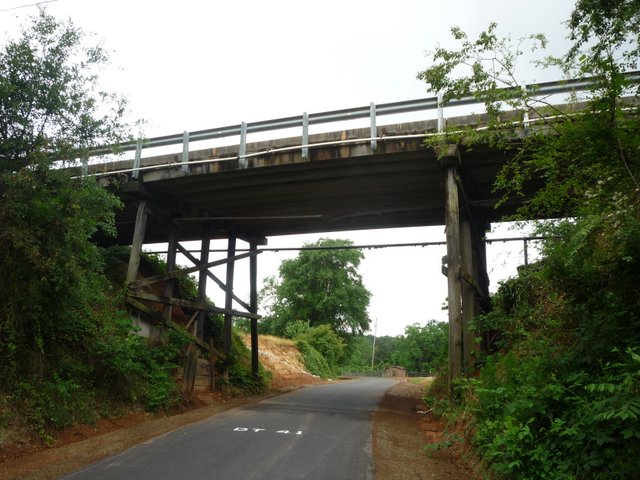
Several miles further along, I go under Ireland Road where the railroad runs through a small cut.
Being an engineer, I check out the supporting structure and find it
"interesting." The roadway is supported on wooden pilings, but the soil
has eroded enough that some railroad maintenance department decided to
shore it up to keep mud off the right of way.
Nice work, don't you think? Here it is from a different angle, in case you have not made a judgment.
Yep. Those are highway signs and railroad ties holding the soil back
Just after this overpass, I see -- and hear -- a fearsome racket. It is a bunch of dogs barking fiercely at me from the deck of this house on Welborn Road.
Here, I have a flashback. A few months ago, I was riding the bike in front of that house. (Second motorcycle tiein.) The dogs were not confined and all of them ran after me. I barely escaped without wrecking. I can't imagine what they would have done with me had I fallen off the scooter. I might not be writing this account for you today.
I did have one consolation, though. One of the larger dogs tried to intercept my front wheel. There were so many others that I couldn't use the usual technique of accelerating before they intercepted me. If you accelerate before they get to you, their calculation is thrown off and they end up behind you instead, with a "how did that happen" look on their faces. As it was, my footpeg hit the big dog pretty hard. I'll bet he thought twice about the wisdom of chasing me that day. I hope so.
Anyway, they are confined today, so, despite some initial trepidation to walk by, I am saved by their deck railing and a secondary containment system -- their yard fence.
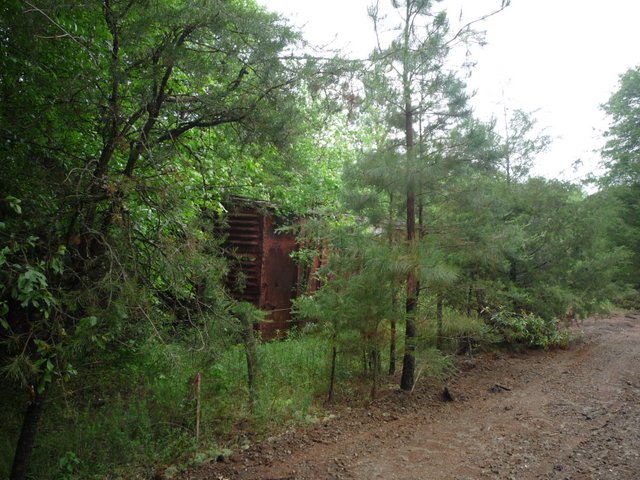
Further along, I spot this old steel boxcar. It has windows and must have been used for work crews.
I later learned that when the Pickens Railroad was struggling to make money on rail operations, they started building boxcars near this old work car. They built the cars and took them into Pickens to be sandblasted and painted, ready for sale.
I walk a few hundred yards further and find there two hopper car end sections sitting side by side and jutting out of the embankment with a steel house on top of one of them.
Compare the end of this complete car.
I can't imagine what the side-by-side arrangement might have been used for.
A few feet from there, is a steel structure built of boxcar or hopper car sides stacked three high. You can't see it very well. I'll have to come back in winter for a better look. This must have been the car assembly building, though I am guessing.
A few days after my foot trip, I mounted up to view this structure from nearby Dublin Lane. (Third motorcycle tiein.) It was very hard to see, but the building is being used for storage of round hay bales.
The other structure made of hopper car ends and the work railcar were not visible from the road.
This steel tank at Turner Road was not owned by the railroad. It was brought in by a hoarder of metal tanks and other heavy metal items. I suppose he expected to sell it at a profit one day.
I spotted a motley mix of stuff in the nearby woods including an early
70s full-size Chevrolet hemmed in on all sides by trees about a foot in
diameter. It'll rust there in its prison, I expect.
That was the end of my travel from the Easley end of the Doodle Trail. A couple of days later, I started at the Pickens end and saw the sights described in the following section.
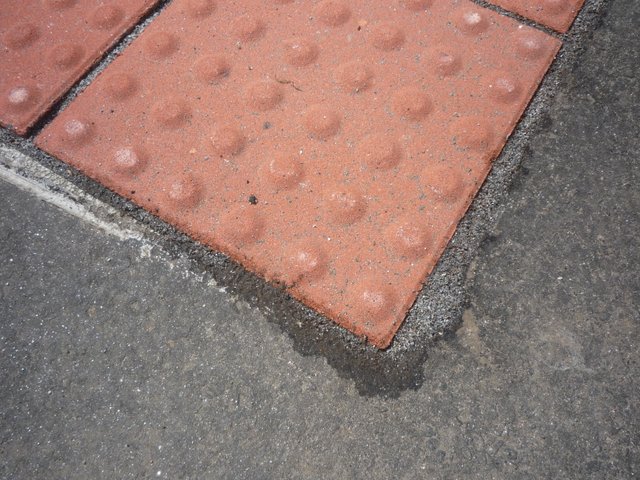
First, I have a pet peeve. At every road crossing, they installed those rubbery mats with the bumps on them so blind people can sense that they are approaching danger.
Unfortunately, they are already loose and sticking up more than a half inch, presenting a major trip hazard to anyone, blind or not.
I have written about this before, where in the town of Newry, they installed them where there wasn't even a sidewalk. Where is the wisdom in spending our hard-earned money on such projects?
A few days later, I find that they have begin replacing the rubbery bumpy things with concrete bumpy things like this.
It still costs the taxpayer a lot of money to put these things on every street corner and possibly dangerous juncture. Surely people have some responsibility to watch out for themselves.
Moving on.
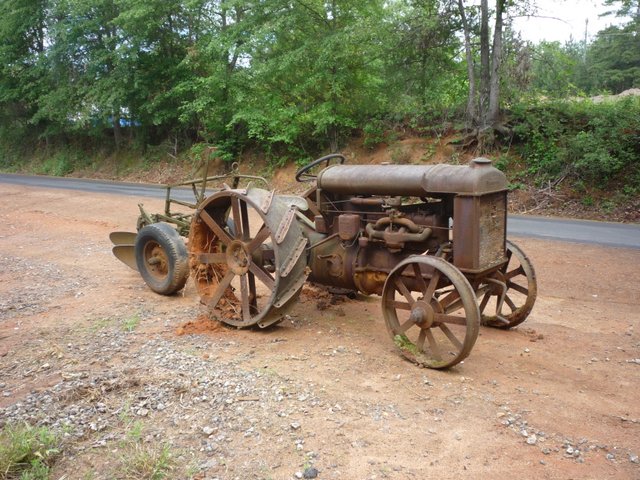
This ancient Fordson tractor and two-bottom plow are sitting alongside the trail. They appear to have been retrieved from having been sunken into the mud somewhere, judging from the look of the steel wheels.
The radiator shroud.
The four-cylinder engine is designed to run on kerosene.
It uses a Holley vaporizer.
To get it started, you switch it over to use gasoline. That is why there is a cast iron gasoline tank nearby.
Once it is running and warmed, you turn it over to kerosene. I think the tractor was sold new in the early 1920s.
Here is a list of patents that are included in this tractor, all cast into a part of the frame.
Here is a picture of a similar tractor, and here is a fine 1/4-scale working model of one.
You can hear one running in this video. Many of these tractors were sold by Ford in Europe. This one is in Italy.
Note that when you start a hand-cranked engine, you always position the crank to pull up on it. You never push down or crank it around and around. This can result:
Not my arm.
And you never wrap your thumb around the crank handle in case the crank does not disengage from the crankshaft when the engine starts. You only cup your four fingers under the crank handle with the thumb out of the way.
Next along the way are three Troy Engberg vertical steam engines in a makeshift steel shed.
I wonder what they were used for.
Still more engineering marvels await along the trailside.
Here is a tracked power crane.
It is also becoming hemmed in by forest growth.
Fortunately, someone has left a bow saw hanging from a convenient branch of a nearby tree.
I am sure it would make short work of extracting the crane from the tentacles of the trees.
I have reached my limit for walking today. (Remember I have to go back the same distance I have come.) I turn on my heel and start back. When I reach Pickens, I explore the trailhead a bit. There is a portable potty here, and the building that housed the former Pickens railroad shop.
This diesel locomotive and several boxcars sit on a short section of trackage here in Pickens. There is no way for them to get out, since all of the rails between here and the main line in Easley have been removed.
The locomotive was purchased in 1947, replacing steam power. It is a Baldwin VO-660. It was numbered 2 and was later named T. Grady Welborn.
The building next to it is mostly empty now, but there is a sign of future hope for it.
As I am prowling around, this fellow rides by on his powerful moped. (Fourth motorcycle tiein.) The muffler was without a packing I am pretty sure, based on the noise level it produced.
If I were inclined to ride a moped, I think it would be one like his
with the large wire wheels. You straddle it and it looks more like a
real motorcycle. Maybe that is my next step -- when I get old!
I sit in my car for a few minutes, eat a granola bar, and gulp down some water. It has been a satisfying couple of days of hoofing it along this new route.