Showing posts with label engineering. Show all posts

Tuesday, July 15, 2014

New Guys

.
A few weekends ago, I met up with a couple of new guys.  Now, these new guys were not just new riding companions, but both of them are new to riding.  I met one of them, Chris, by following him home the previous weekend. 

That sounds a little creepy, but, in fact, I happened to be nearly home from a ride, saw him, and followed him a mile or so to his house.  I introduced myself, and offered that we could ride some time. 

We made arrangements for the next weekend, and he asked whether another friend of his, Austin, could come too. 

Well, we met up at the local Dunkin Doughnut shop.  Before you get the wrong idea based only on our meeting place, there was only one guy on a cruiser – and it was a Triumph.  Don’t y'all go stereotyping us on our food preferences, please. 

Anyway, it turns out that both of the new guys are engineers, and as you recall, so am I.  Speaking of stereotypes, I have to admit that this is one place where a stereotype might be accurate.  Here we have three engineers, all a bit introverted, so you can imagine the conversation… 

…or lack of it, to start. 

“Hello.” 

“Hi.”

“I’m Bucky.” 

“Glad to meet you.” 

Then a pause.  You see, engineers tend to dwell on facts, not fluff.  We are models of efficiency.  We’d already gotten all the niceties out of the way, and now we were flummoxed on what to say next.  We needed some more facts. 

We finally did get the conversation cranked up, but, even so, quite a bit of it was about business, and engineering, motorcycling, and other technical topics. 

Once the appropriate number of doughnuts had been consumed, we discussed the ride route.  My engineering bent came out again, as I distributed annotated maps, and explained where we were going, the road difficulty levels, how to space ourselves, that you should look where you want to go, you should not try to keep up if you are on the edge of fear, etc. 

Here is the route we had planned: 

I don’t lead group rides very often, but I try to do a few things right when I do.  One thing is to give the basic rules of group riding, amongst them staggered lane placement, to ride your own ride, and to look where you want to go, no matter what.  

Another thing that is important for the leader to do is to start out slowly after a stop or turn so the others don’t have to go too fast to catch up.  I find that I have to keep reminding myself of this throughout the day.  Jackrabbit starter, I guess. 

After a prayer for safety and enjoyment of God's creation, we geared up and were off.

I remember when I was at the stage these guys are.  My then new friend Ryan helped me start through my learning curve on the trip he led me on to Saluda North Carolina, way back in 2009. 

I remember too, because of the sensory overload of learning to ride, I couldn’t even remember what gear I was in at first.  He verbally coached me half way through the ride when we stopped for a soda pop, gave me signals on the proper gear selection from his bike as we went, and demonstrated the correct lines though the curves that, for him, were being taken at a painfully slow pace. I didn't think so at the time.  

---------------------------------------------------------------------------
Note: The following account includes comments made by one of the new guys himself, in bold typeface, and prefaced by his name. 
---------------------------------------------------------------------------

The initial route today, leading to the north and west from the town of Pickens, SC is pretty easy, with some sweeping curves, until we hit SC-11, which is wide and almost straight.  Then we turn to the north onto SC-130 toward Whitewater Falls.  This turn is a tight right-hander that sometimes has gravel in it.  Today it doesn’t have any, but I make it a point to go a little slower than usual because of its tightness.  I watch my rear view mirrors, and the others seem to have done all right – they didn't go wide into the opposite lane. 

SC-130 has many more sweeping curves over the ten miles or so we will travel on it.  Most of them have good sight distance, so the riding is not as difficult as it could be. 

This bicyclist was stopped along the way, but not quite off the road.  We slowed down and gave him a little room as we passed.  He doesn't look like he is a hard-core rider like I saw last week -- and almost got to know too well -- on the ridiculously twisty roads I traveled then. 

There are a few places where the pavement has begun to break up, though.  One pothole in a curve catches me by surprise, and I hit the edge of it.  Chris hits it on the edge as well, and later said that it caused his front wheel to be pitched aside, and made him feel very unstable.  The edge of the pavement loomed too close, and he thought he might crash as a result.  He didn’t, though. 

That’s good. 

Chris:  One of my biggest fears while riding has been potholes (among other road condition hazards and of course, other drivers).  I’ve had friends and family members have motorcycle accidents caused by a pothole that came up too quickly.  So, upon seeing this particularly large pothole my first thought was “do I have enough time to react?”  The next thought was “No, you’re going to have to hit it.”  Unfortunately, I hit the edge, which caught the sidewall of the front tire.  With better skill, I probably could have entirely avoided the pothole without adding any unnecessary risk.  The jerking motion that it placed on the front tire was more than I had previously dealt with, so it wound up being a good learning experience. 
 
I am not sure why, but we arrived at the Bad Creek Pumped Storage Facility entrance (just south of Pushpin B on the map above) more quickly than I expected. 

Maybe I was paying attention to how the others were doing, so my mind was occupied with that and riding my own ride.  Maybe there is a lesson here – that I should go at a slower-than-breakneck pace [at least slower than Bucky’s breakneck pace, which is a lot slower than for most other riders] and enjoy the ride and the scenery more.  

At any rate, it was an enjoyable several miles, and I could imagine how the new guys felt, as I recall my first trip up this road.  

We turn into the Bad Creek gate and ride down the road to the overlook just above the powerplant.  The road is a little rough and has more tar snakes than any other road I have been on.  These can be quite slippery when wet or when the temperature is very high.  We don’t have either problem today, however. 

The overlook comes soon enough,...

...and we park the bikes.  I notice that the new guys are watching to see where and how I am parking.  They follow suit, and do what I do. 

I didn't realize it at first, but I think I am being a role model here too, so I’d better not teach them bad habits. After all, parking the bike in a good spot and with good technique is part of riding well.  They did fine. 

We dismount, and walk over to the view of Lower Whitewater Falls, to our left.  The light is sensational today.  The view is great.  I describe what we are looking at.  Lake Jocassee down below, the falls in the center of the frame, and, of course, the pumped storage facility powerplant location at the left end of the lake.  They eat up the details of the powerplant operation, like any engineers worth their salt would. 

The operation of the Bad Creek Pumped Storage Powerplant Facility is described in one of my earlier posts, from 2009.  (That's also when I went quite a way into the gravel Musterground Road that starts nearby.)

Hmmmm.  Discussing powerplant operation.  Now we’re talking: Technical stuff! 

Once we have glanced at the views a little more,...

...we turn to looking over the bikes.  Chris has a Suzuki SV650.  He has been riding only a month or so, and relates that in first and second gears his ride is pretty twitchy, lifting the front wheel easily.  We talk about fuel injection systems sometimes being sensitive just off idle, and how throttle hand positioning with the wrist straight might help. 

Chris:  I bought the SV650 based off recommendations from other riders and forums online.  While it was often regarded as a “good beginners bike that you won’t outgrow overnight,” I believe those regards are quite biased.  I had a difficult time learning how to ride on the SV because it is far less forgiving than the more widely-regarded beginners bikes (Ninja 250/300, Virago 250, etc).  The most difficult part was focusing on proper technique/mechanics without letting that detract from awareness.  In retrospect, learning would have been easier on an actual “beginners bike.”  

Chris’ bike had been in a spill before he bought it, so it has a few battle scars here and there, and he is figuring out where the lower cowlings are supposed to reattach.  I didn’t realize that some of the plastic was missing until he pointed it out – the naked look to it is becoming. 

He also mentions that he has noticed that the bike sounds different after he has been riding for a while.  I conjecture that this is because of the wind noise effect on hearing.  The ears become less sensitive after having been subjected to noise for a period.  I suggest earplugs as being vital to prevent this, and long-term permanent hearing loss. 

Chris:  I had noticed some riders wore earplugs and others did not.  During short rides at lower speeds (such as in my normal commute), I never noticed any hearing loss.  However, longer rides had a profound impact in my hearing after about an hour.  Earplugs seem like the perfect solution.

He asks about where I got my riding boots.  I tell him, that I find my gear wherever I can – e-bay, local friends, Amazon, CycleGear, other on-line websites, and pawnshops, to name a few.  In fact, I have been collecting gear since before I had a motorcycle.  [Closet motorcycle enthusiast, were we, Bucky?]

Maybe. 

Well, I confess, it is true.  I have longed to do this for many years.  It just took me until most of the way through my fifth decade to get started. 

My leather riding suit was purchased many years before at a pawnshop that seemed to have collected too many such suits.  I remember making weekly payments until it was mine.  What I was going to do with it, and when, I had not the foggiest idea.  As it happens, it matches the bike I eventually purchased pretty well. 

Chris:  I purchased a decent padded riding jacket and gloves along with my first motorcycle.  I had a good Snell/DOT helmet from a previous automotive hobby.  However, I did not buy good boots and pants right away.  Jeans and sneakers are just asking for trouble - especially when there’s virtually no ankle protection.  After our trip, I started doing some research on a good set of riding pants and boots.  My attitude is “if it’s too hot for gear, it’s too hot to ride.”

Austin’s bike is a Triumph cruiser.  It is a sharp-looking bike, mostly black with a little chrome, and it is no slouch on performance.  Even though it looks as though it is equipped with carburetors, in reality, it is actually fuel injected for modern-day performance and emissions regulation compliance. 

[There you go, talking technical some more.] 

We saddle up again for the short trip to Whitewater Falls.  There, we park and walk the path to the falls overlook.  Again, the ideal lighting of the day displays the cataract beautifully. 

We linger here, and snap a few pictures, along with a small group of tourists.  We gaze at Lake Jocassee in the distance on our way back to the bikes.  

I again have Déjà vu.  I have been here to the falls many times, but my first time here was somehow special.  I remember it well. 

I shed a layer of insulation, as it is getting hot.  It is supposed to be in the mid-80s today.  The humidity is still low, however, so it is comfortable.  It is an ideal day for riding: good temperature, clean roads, not too much traffic, and extraordinarily clear views of the distant scenery. 

As we are readying ourselves to continue, I ask whether the pace so far is about right, too fast or too slow.  I make it a point to have no inflection in my voice to betray what I may be thinking.  One of the guys, his eyes getting a bit bigger, ponders about it a little, and says that he certainly doesn’t want us to go any faster. 

Chris:  I felt that our pace was safe yet still challenging.  As Bucky had stated earlier in the day, “confidence builds before skill,” and I surely didn’t want to risk harm to be convinced of that point.

OK.  Message received.  [Bucky, take it easy, today.] 

Just in case the pace really is too fast, but they’re not saying, I also tell them that if they are tightening up on the bars in the curves, to slow down a bit for the next ones. 

I describe the stopping point coming up, only a few miles from here: That nice surprise I have written about before. 


The exit from the falls parking lot onto 130 is uphill, and requires good clutch technique.  It sometimes has gravel on it, and the sight distances are not all that long.  Like our sharp turn a while ago, there isn’t any gravel today, and all three of us get it right coming out.  We are again on our way, traveling a little bit to the south now. 

We take a gentle right onto the Wigington Byway, take it easy on the downhill turns here, and in just a few minutes, we spot the surprise overlook on the left.  We have passed a few stray bicyclists along here, all with number tags pinned to them.  Must be some sort of race or organized ride. 

I pull into the overlook and use my best parking technique, but too late notice that the slope of the pavement doesn’t allow much lean onto the kickstand.  Chris’ bike won’t stand up, so he has to restart it and try again.  I suppose this is a teachable moment for him, but I should have picked a better place to park so he didn’t have to move his bike. 

Chris:  I’ll admit - I don’t get the “warm and fuzzies” with the kickstand on the SV.  To me, it doesn’t point forward enough for me to feel comfortable walking away without giving the bike a test “nudge” first.  Re-angling the bike helped ensure that it was stable on the hill.  When learning how to ride, I feel that evaluating how to park is often neglected.  I now make a point of giving my bikes a solid nudge in all direction to make sure they won’t fall over as soon as I walk away.

When Chris restarts his engine, I hear a discordant ringing sound -- like a cowbell.  I turn to see a dismayed look on Chris’ face as he looks down at his machine, wondering where this new noise is coming from.  Something has certainly come loose, big time.  Strange thing is, it continues when he switches the engine off again! 

Chris:  In my drag-racing days, I heard the lovely sound of the transmission in my race car eat several gears and snap a shaft.  Since then, you could say I’m a bit paranoid when it comes to odd mechanical sounds…

What could it be? 

The real culprit is that there is a woman with a – wait for it – cowbell, ringing the fire out of it as the bicyclists struggle up the hill.  A bicycling buddy at work says that this is fairly common, especially in Europe, to encourage the riders.  I thought it might be to let them know that there are snacks and a Porta-Potty waiting for them here.  Silly me.  They also do it for snow ski racers, I now understand. 
I need more cowbell! tee shirt

Whew.  With the sound of the cowbell, I had visions of ground-up doodads, gizmos, and thingamabobs [all engineering terms] falling onto the tarmac from the engine, and having to call for a tow. 

Aside: How in the world did they start using cowbells for this purpose?  The Internet provides the absolutely correct answer, as usual, and I will quote it for you here, from the Beginner Triathlete forum poster Sneaky Slow.

Actually, it started back in the first Ironman, back in Hawaii.  Dave Orlowski, one of the original Ironman finishers, a dairy farmer, who provided fine milk to the big cheese plant outside of Madison, was originally a Wisconsin resident.  He made the long and arduous journey to Kona to participate in this strange and wonderful race; in fact, it was his first time outside of the great state of Wisconsin.  He was awed, and in fact a little overwhelmed, the truth be told, to be so far from home, participating in such an intimidating event, the sounds, smells, and sights of the Big Island so foreign to him, a simple cow farmer from Prarie Farm, WI.

He managed to make it through the swim, but thoughts of pastures, cowchips, and cheese hats soon consumed his mind on the bike.  In the middle of the bike leg, he was struggling, feeling uncomfortable, wishing for a familiar face, a friend, something to get him through those next few long miles.  The sweat poured down his forehead... all he wished for, was a piece of cheese; something to remind him of home... comfort... alas, there was no cheese to be had in his Bento Box, as the searing heat coming off the lava fields had rendered it to mere Cheez Whiz.  And who wants Cheez Whiz at mile 60 on the bike?  Not even a Wisconsin dairy farmer.  He began entertaining thoughts of quitting...

And then he heard it.

Off in the distance, a familiar ringing.  Could it be?  The sound got louder as he pedaled on, his stroke becoming stronger, more confident with each "ring" echoing through his ears.  There was Sally Gunderson, who had made the trip, unbeknownst to our hero, all the way from Wisconsin, just to ring, ring, ring, that cowbell, and spur Dave onto the finish line.

The rest, of course, is history.  The story of Sally and her cowbell and how it rescued Dave from a certain DNF was told and retold, and now, at all levels of triathlon, the course is lined with folks just like Sally ringing, ringing, ringing, that cowbell.

Hope that helps.
Sounds like a true story, right?   Here is some more


Back to the new-guys ride now.  

That crisis, solved by luck rather than by engineering acumen, is behind us now.  Thank goodness for that.  

I note that the others' parking technique is exactly like mine: backed in, downhill at the rear, rear tire against the curb.  

Good job again. 

The two engineers, while looking at the pretty view of Lakes Jocassee, and further into the distance, Lakes Keowee and Hartwell, spot something on the furthest horizon a little to the left.  They say it is something square in shape.  I struggle to focus my tired old eyes on the object.  I go and get my map, and we figure it is the skyline of Greenville, about 38 miles as the crow flies to our east. 

It is seldom this clear up here, so this is a rare chance to view the scenery. 

I explain the next leg of the journey, which includes the very large intersection where Wigington Byway intersects SC-107.  You can’t see very far around the bend in either direction, so we have to be careful pulling out.  SC-107 is also more twisty than the other roads we have ridden today.  And it is mostly downhill, though not steeply, so the riding is more difficult than the almost-steady uphill we have had for a lot of the ride so far. 

Today I don’t describe the technique of slowing for curve entry and holding at least maintenance throttle on downhill turns, but maybe I should have so that they would feel a little more in control and comfortable along here. 

I try to set a good example of proper lines and a moderate pace, but a few times I feel that I may have entered a little hotter into some curves than I should have for them. 

They don’t have any trouble that I can spot in my mirrors, but I expect that they might be feeling a little uncomfortable through here.  There are a couple of spots with sparse gravel, too.  In a section of repeated S-curves with some on-coming traffic, it would be easy to target fixate on the wrong thing. 

We continue onto SC-28, where there are a couple of tight sections. 

They do fine, but I notice that they are falling way behind on a straight section after all the curves. 

I see what the trouble is only after I slow down to allow them to catch up.  A LEO has been on their tail.  Good reason to go slow. 

We stop for fuel, and get on our way again.  The last stop is the Oconee Nuclear Station Visitor Center.  I notice that neither guy is behind me after the left turn into the driveway.  One of them has forgotten to shift down into first gear as he stopped to allow oncoming traffic to clear.  He had trouble getting into the right gear for the turn. 

Chris:  As I approached the entrance to the nuclear station, there was no opposing traffic.  2nd gear felt like the right gear to be in.  As I got closer to the entrance, a car in the opposing lane came into view.  I kicked down into 1st (rather, thought I had), and stopped.  Once the car passed, I rolled onto the throttle and slowly released the clutch as normal.  Except, I wasn’t moving.  Unfortunately, the reactive motion of kicking into first as soon as I realized I was in neutral was enough to stall out, as I neglected to pull the clutch in before doing so.  It only took a second to start back up and move, so I’m hoping my rookie mistake wasn’t too apparent or annoying for the traffic behind me. 

I remember doing that a lot when I started.  

The nuclear plant visitor center has nice displays about power generation, including its history in the area and about generation by hydroelectric, coal, and nuclear means.  By the way, this nuclear plant has generated more power than any other in the United States. 

The engineers in us take in every detail, as you might expect. [Surprise, surprise, Bucky.]

When we have seen everything, we go back out to the bikes and say our farewells.  We will each peel off as we get closer to our homes.  It is getting to be that time, that in every good ride, we would rather it not come around. 

I had a good time today, seeing some of the many great sights we have in this area.  I hope I have helped these guys a little in their riding. 

...and I hope my mentor Ryan would agree. 

---------------------

Other References:


Bucky

Thursday, May 15, 2014

Chores

.
Last posting, I mentioned that I had to get back home from a ride on some ridiculously twisty roads to do chores.

You might know that I occasionally do some things not related to the scooter -- like work for a living.  But I also have to keep up the old homestead and make sure several vehicles besides the bike are alive and kicking. Seems like a full-time caretaker/mechanic is needed. 

I think those are amongst the reasons my wife has me around. 

My bride decided last year to do some vegetable gardening in the back yard.  She planted a bunch of crops in containers on the patio and had luck with a few of them.  This year, she asked if she could buy a greenhouse to get an early start on the growing season, and so that some plants could winter over without dying in the cold.

Of course, she had one all picked out.  The one she spotted was about 6' by 8', item #47712 at Harbor Freight Tools.  It was on sale, after all, and they always have coupons for a further percentage off.  She claimed it to be such a great deal that we couldn't afford not to buy it. (Can't argue with logic like that!) 
Not my wife
The thing came in a corrugated carton in about a thousand pieces, with marginally passable instructions on how to assemble it.  My engineering degree was taxed significantly trying to figure out the whole scheme, however.  The aluminum extrusions that form the frame are as light as they possibly can be and still survive the assembly process.  In fact, if you don't have a couple of helpers in the early stages, the pieces all collapse into a spaghetti-like heap on the ground. 

Oh, by the way, it doesn't come with any kind of a foundation or anchoring means.  My architectural engineering skills were tested as I tried to devise the best way to support the thing and keep it from blowing into the neighbor's yard in the next windstorm. Concrete is too permanent, a lot of work to install, and causes the tax man to come around, so that was not an option.  Maybe wood? 

I settled on a perimeter frame of 2x10s set on edge with a deck board floor so my wife wouldn't have to soil her shoes in the dirt.

The whole thing is supported on an array of several patio blocks, and anchored with these twisty things [engineering term] from Amazon: 

Liberty Outdoor ANCFR16-ORG-A Folding Ring Anchor, Orange, 16-Inch

(Be sure to call your utility company before you screw them into the ground.  If there is an electrical or gas line under there, you could be in real trouble.)

And don't try assembling the greenhouse pieces in any kind of wind.  It can't be done, even in the gentlest of breezes.  (I know.  I tried it.  Twice.)  

Once the wooden foundation and floor were assembled, I began constructing the aluminum frame on top of it.  Did I mention to you that it is like screwing together a gob of cooked linguine?  Well, it is pretty much like that, anyway, the frame pieces by themselves being feather weight and flimsy. 

That's me in there. 

A little further along. 


There were more than 120 screws and nuts to hold the frame together.

Once the majority of the framework was screwed together, the house began to have some substance to it, and it would stand on its own.  I lag screwed the bottom flange to my wooden base.  Finally, I felt confident that it wouldn't take off on its own.


With the corrugated polycarbonate panels in place, the thing was actually quite sturdy. 

The sliding door operates smoothly once I got the whole house square, straight, and level.

Of course, I couldn't let well enough alone.  I had to provide running water and power and gas for a heater so my sweetie would not have to over exert herself to keep the flowers and vegetables perky. 

There is a concrete sidewalk next to the greenhouse, under which these utility lines must be run, so out came a piece of plastic pipe attached to a garden hose to burrow beneath it.  After many hours of trying to get this done, I decided that there was no way to do it in the spot I had picked, so the power comes in by a heavy duty extension cord and the water runs in a hose across the sidewalk.  Must be some rocks or concrete under that sidewalk. 

I will worry about the gas line when it gets closer to winter again.  Nothing like procrastination -- with good excuse, however. 

The area surrounding the greenhouse, of course, could not be left in turf, so I had to till it up and kill the Bermuda grass (nearly impossible, I might add, it being the closest thing to a weed that money can buy).

My loving wife next advised me that she had invested in a pond liner so we could install a fishpond for some fish we don't have.  I was quite critical of this because it would require extensive manual labor to dig a hole that needed to be, oh, say, about 12 feet deep, it seemed to me.

I was also more cognizant than she of the fact that the neighbor's several cats might be very good fishermen.  ...or at the very least, the resident raccoons would finish off any fish we might supply.

Nevertheless, the pond was a go.  

It took a while to figure out how to make the hole in the ground the right size for the blow-molded plastic liner.  The way you do it is to dig a gigantic hole, level a place in the middle with sand, set the liner in place, then pour many more bags of sand around it.  The plastic liner was warped, too, adding to the challenge, so I had to partially fill it with water, then pack the sand under and around it to force it back into its correct shape.

MacCourt 50-Gallon High-Density Polyethylene Pond Liner,
Model #: LP5718


(The local Lowes store manager loves to see me come in lately. Lumber, pond liner, electrical and plumbing supplies, sand, etc., etc.) 

Did I mention the rocks? Well, any good pond in your garden needs rocks around the edges.  So we went to the rock store and brought a trailer of rocks home.  Each one was carefully placed, per instructions from my supervisor -- er, wife.
This is too much like real work!  (I'd rather be out riding, but I didn't let on to my wife.  ...and I was enjoying the project, I'll admit.)

To provide entertainment for the fish we don't have, and for any onlookers that might be about, she got a little pump that connects to a cast toadstool that has a frog sitting next to it.  The frog squirts the water out of his mouth and back into the pond.   High class, yes?

There is a downside to the spitting frog, however.  When sitting in our lawn chairs nearby, the trickling sound of the water makes you feel like you need to go trickle too.  It is very effective at this, I might say. 

Four tiny goldfish were hand selected by my wife at the pet store, and relegated to the deep.  We didn't see them for several days.  I was sure the cats had gotten them already.  Instead, I think they were hiding from us -- and from the cats and raccoons.   They are a little less skittish now, so we occasionally get a glimpse of them at feeding time. 

Plants galore were purchased to set around the greenhouse and in the new garden.  Perennials, and tomatoes, and other neat things were dispersed into almost every available space.


Did you notice those round stepping stones.  That is a story too.  My wife poured them, using pretty glass globs in each form for decoration.  She did this all by herself.  Great girl, she.

This well-behaved tortoise seems to like it here.  At any rate, he hasn't tried to move out yet.  

Our Republican mascot has a prominent place.

Another view of the pond, now with seashells surrounding it.  The fish feel right at home with the seashells, I am sure.

What do you think of the project?

That was certainly a chore, now completed.  It looks nice, and it makes my wife happy.  That makes it worthwhile.  And the greenhouse might provide us some vegetables later. 

Lest you be overly concerned, I did manage to get in a few rides between the work in the yard and the greenhouse. 
.
.

Saturday, February 23, 2013

Quiet Parks and a Winter Route

.
Last time I went out for a ride, I looked at Google Maps to find some new places to go.  Since it is winter, I usually don't go north into the mountains -- might be ice or sand on the road.  I don't need to be slip sliding around. 

Instead, I look for sights that are new to me in the other three directions.

I pick out three parks, generally south of home, Sadlers Creek State Recreation Area, Hart State Park, and Tugaloo State Park.  By the time I complete the route, I will have gone into Georgia and circumnavigated the major part of Lake Hartwell, shown here in a satellite view, and found a highway with some nice sweepers: 

© Terra Print

The three rivers that form the lake are the Savannah, Tugaloo, and Seneca. It covers 56,000 acres, about 88 square miles.  

It is a little cold again this morning -- 28 degrees -- but I can handle it fine if I dress right, and it will warm up later. 

I start out on US-178, the road that, to the north, is a favorite of motorcyclists around here.  In the direction I am headed, however the road is very mild.  There is not much traffic this morning, so I can move right along and enjoy the sights.

I find Sadlers Creek and go in.  There are a few boat trailers, parked, so there must be some fishermen and recreation seekers about.  Not where I am, though.  It is quiet and there is no human in sight.  The water level is low, due to the recent dry weather, so there is a lot of normally-submerged area at the edge of the water.

This would be a serene place to enjoy the view and maybe drown a few worms. 

I snap a few pictures of my trusty steed.

From the shore. 
It would be pretty in the fall here, I expect, but probably not as quiet. 

There is a fine picnic pavilion on the water with this entrance forming a frame for the focal point of my photo, my silver Ninja.

They even have a basket of various balls and rackets for visitors' use.  How thoughtful. 
I don't take them up on using them today.  .


Next up are some more mild roads, and then to Hart State Park, for another pic of my baby.
This time, I spot a speedboat out on the water, near the far shore.   No skier behind, though.  Must be wimps, since the temperature must be way up into the 40s now. No telling what the water temperature is, though. 

No other people around.  Again, quiet, but a nice place to sit and watch the water and wildlife.

Nearby, there is a boat ramp with this important road sign on the way to it: 
I didn't keep on going into the drink.  [Pretty smart of Bucky, don't you think?] 

After I leave Hart, but before I reach Tugaloo, in Georgia. I cross the bridge over the Savannah River with a nice view of the Hartwell Dam a little to the north.  Since 1963, this dam has generated quite a lot of clean hydropower. 

A little road west of the river crossing leads to the powerhouse.  Being an engineer, I can't pass up this opportunity to see some engineering on a grand scale.  Just before reaching the powerhouse, I stop and take my bike's picture. 
 
When I get closer to the powerhouse, I see a sign that says that photographs are forbidden.  Oops. Well, nobody seems to be ready with the handcuffs just yet.  Maybe I was further away when I took the picture than they care about. 

There is a little place to camp and have a picnic along the Savannah River downstream of the dam.  The riverbed is very rocky, with rounded-top lumps sticking above the water's surface, like a multitude of bald heads grouped together.  The dead end road along the river passes under the road I came in on, US-29.  A guy riding a Monster and wearing a race suit passes me on this little road as I am taking the pictures, but he seems to be in a hurry and doesn't stop to chat.

Here is a photo from near the top of the dam, looking downriver toward the 1958 highway bridge, taken on my trip to Lawrenceville Georgia in 2009. My current location is on the other side of the river, beneath the bridge.  Downstream of the bridge is Lake Russell, another large, man-made lake. 

The river is lower today than back then, exposing more of the lumpy bald heads.

The view from under the bridge I had passed over a few minutes earlier:

I don't see Monster guy again.  He is probably tearing up the roads somewhere way ahead of me. 


Next up is Tugaloo State Park, Georgia.  I couldn't find many picturesque views, and, again, there are no people around.  I guess it is too cold out.  There is a nice picnic shelter, and a playground nearby. 
(Before you comment, there were no handicapped people there, and I only stayed a minute.)
I spot a road hazard nearby. Can you see what it is?

Look closer:

Acorns.  Lots of them.  Like ball bearings.  Even a car might be in trouble here.

I avoid the hazard, though.

Now to the highpoint of the ride today.  A road on the way back home.  It is on this map, between Pushpins D and E. 


View Larger Map

It isn't very twisty, but it is a 15-mile series of sweepers that is enjoyable to ride, like a shorter version of my earlier posting about Sweepers, Galore!  This surface is clean, and in good condition.  It makes part of a good winter route.  I will have to build on it some time.  There isn't much traffic, and I like the free feeling of guiding my two wheels through the curves.  Another road that is all sweepers is the one that leads to Whitewater Falls, my first trip there is described here

I think this is one of the ways I most enjoy my scooter.  I like a few tight twisties in the mountains, but I am not that fast there, a little error could be a big deal, and there are certainly many hazards that could cause trouble around the next bend. 

At the other end of the road spectrum are the almost straight roads.  They are not technical enough, and it is easy for the mind to wander -- not a good thing in any case. 

I enjoy my 182 mile ride today, especially this curvy part. Yes, the sweepers are the best for me.  How about you? 
.

.

Wednesday, May 4, 2011

Saluda North Carolina -- a Tag Grabbed, and More

.
April 2, 2011, about a month ago.

I had to find it.  What?  Another tag by Stretch in the CarolinaRiders Forum Tag Game.  Recall that Stretch is a pretty good one at posting tags that are interesting and somewhat difficult to findAnd here is another one Stretch posted.  I have prided myself in finding a few of his tags, but this one looked quite interesting to me because of my engineering background.

It is an old waterwheel, and his clues were are follows: 
"Here's a tough one.  The Carolina mountains are covered with old water wheels. What makes this one unique is its proximity to the water.  Bonus points if you can tell me how it worked.
"If you ride down a road in NC with 21 hairpins in about 2 miles (there's only one), you'll find the new tag about 11 miles from the last hairpin turn."
One of the other inmates [members] on the forum posted this:
"Can I ask questions?
"For instance; can I find this road with "21 curves in about 2 miles out of Saluda, NC?"
Stretch replied:
"It may be near Saluda. I'm having a little trouble remembering just now .
"On the return trip I recommend passing the unnecessarily twisty road and taking the next right instead. I find it a more enjoyable ride and it will return you to the same town, whatever that town may be."
 
...and provided a couple more clues: 
"When a group of businessmen from Spartanburg, SC needed more power for their mills, they bought land in NC to build two dams. This mill wheel is near one of the two resulting lakes but predates Dam.
"Look for a road named after a famous Golfer."
Well, one cerebral part of motorcycling is to figure out clues like this.

I am sure the twisty road Stretch is referring to is the most contorted piece of civil engineering I know of around here, Green River Cove Road.  I tested out a downhill rear-braking technique here last year, but I don't like the road much because the turns are very sharp, and visibility of oncoming traffic is poor.

I carefully map out another eleven miles from the last (lowest elevation) turn on that road, and find that it is beyond the northeastern end of the road, so I must have to go one way or the other after that.  I looked up waterwheel, but found nothing close.  Well, the only golfer I know of besides Tiger Woods is Arnold Palmer (being the sportsman I am), so I try Palmer Road.  There is one up that way. We'll see if the clues will lead me to the right spot. 

I finish up a Google map, print it, slide it into my tank bag, and head out.  It is 42 degrees, so I bundle up a bit, but not too much, as it is supposed to reach about 70 later. 

I go north on SC-135, then SC-186, US-276, SC-11, US-25, and turn off on the Greenville Watershed Road.  This is a moderately twisty road that winds its way uphill through a watershed for a reservoir from which the city of Greenville gets some of its drinking water.  There is no stopping allowed along this road to help prevent water pollution in the lake.  The road is used extensively by bicyclists, so you have to be careful, since some of them ride in the middle of the lane, it is slow going for them going uphill, and there are blind curves in some places.  The pavement has become rather poor, with lots of cracks and potholes.  It is pleasant enough road nonetheless, but the posted speed limit is probably the most prudent way to travel here.


View Larger Map of the Greenville Watershed Roads


Soon enough, I reach the town of Saluda.  I park, and go right over to the M. A. Pace General Store to visit Mr. Robert Pace, son of the original owner who opened the store in 1899.  He is getting up in age now, so I want to say hello to him once again.  Each time I have come through here on the bike, I have stopped, and every time, for some unknown reason, Mr. Pace has commented on the fact that I look like I just stepped out of a spaceship.  Strange, don't you think? 

Here is a clear view of his store from my parking spot.  

I walk over to the front door.  Sadly, I find a sign that says he passed away in his sleep last October at the age of eighty-seven.

His last few years were spent meeting visitors and explaining the history of the business, the steep railroad grade that crests here, and of Saluda itself.  That seems like a good close to a life here on earth. 

Even though it has been several months since he left this world, the stock in his store is as it was.  Only the refrigerated items have been removed.  The ancient stock of dry goods remains, as do the more modern items. 
Those are boxes of new old stock shirts, and shoes on the shelves to the right. 
 

Mr Pace was a former insurance and real estate broker, and a 1945 graduate of Wofford College. He served on many committees and boards that were instrumental in bringing business to the area.

Here is a picture of Mr. Pace I took in April of 2010.
Although I did not know him well, I will miss him. I had hoped to be able to shake his hand just once more. 

I walk down the surprisingly busy street -- after all it is a beautiful day to be out in the mountains -- to the offices of Saluda Realty and Construction.  I find Mrs. Eargle sitting outside in a rocker with her dog leashed nearby.  I speak with both, pet one of the two on the head (guess which one), then inquire of Mr. Eargle's whereabouts.  I venture inside the office where I am directed, and find him at work at his desk.  As soon as he turns, he flashes a huge grin, and says he remembers me from my last visit.  I am flattered.  Maybe the clothes are the reason he recognized me. It had worked with Mr. Pace, didn't it?  Or maybe Mr. Eargle is just one of those fellows who remembers everyone he meets.  He seems to be genuine, not put on, in his treatment of others.

We chewed the fat for a few minutes.  Mr. Eargle told me the story of the old Thompson’s Store and Ward’s Grill (referred to in my earlier posting and pictured below).


A gentleman named Clark Thompson now owns the store and grill, and writes a blog called Saluda Memories.  Mr. Thompson was born and raised here, but went away to college and to work elsewhere.  He returned in 2010 to keep the spirit and nostalgia of the Old Store and Grill alive.  Mr. Eargle's construction company has been restoring the structures. 

After I leave Mr. Eargle's office, I give their dog a little more attention, then survey the remainder of the main street, and saddle up again.  I want to get that waterwheel tag before anyone else does.

Off I go, leaving Saluda (at Pushpin "A") toward the northeast, Interstate 26 (Pushpin "B"), and beyond.


View Larger Map

I could take the first left after 26, Green River Cove Road, the contorted one that Stretch referred to in his clues, but straight ahead, Holbert Cove Road, is more uniformly twisty, with none of those very tight turns all packed together.  And it ends up in almost the same spot.  The road has recently been tar and chip surfaced, so it exhibits a uniformly good grip with no potholes or cracks.  The work must have been done long enough ago that the loose stone has all dissipated, so I cruise along smartly.  The only thing is that there are few advisory speed signs, so it is difficult to know whether there is a decreasing-radius turn or some other hazard lurking somewhere ahead.

After about 9-1/2 miles on Holbert Cove, I reach Silver Creek Road (Pushpin "C") and make a left.  I pass this end of Green River Cove Road, then after 1.7 miles from where I turned onto Silver Creek, I see Palmer Road to the left and Lake Adger Road to the right (Pushpin "D").  I take Palmer Road and begin watching closely for my target.  I come across it, in about 1.2 miles, on the right.

Here it is, at Pushpin "E": 
35°19'42.49"N   82°15'9.72"W
The waterwheel is an example of an overshot style.
Types of waterwheels are described on this website.  

The source of the water was Bright's Creek a bit upgrade -- toward the left in the picture above.

Up a steep slope from my parking place, there is a corrugated steel pipe, shown below, that directed water from upstream to the top of the wheel, probably pouring onto the wheel from a wooden flume, now gone. 

Water exited the wheel through a cut or culvert just in front of my bike, joining the nearby creek across the little gravel driveway here.

The wheel has a large bull gear on the side that engaged a much smaller pinion, providing an increase in RPM to drive a generator.

There may have been a mechanism to govern the flow of water to maintain the correct voltage and/or frequency. (You electrical engineers: Was this likely to be a DC or AC generator?) If you want to do a few calculations on the power provided by waterwheels, here is a website to help. 

This photo shows the pipe at left-center, upstream of the wheel, at the entrance to Bright's Creek, an upscale golf development with a Tom Fazio-designed course.  (Now I know another golf-related name besides Tiger Woods and Arnold Palmer.)  
Wherever the pipe connected with the creek upstream must have been some distance away judging from the height of the pipe versus the creek bed beneath the bridge.  I couldn't follow the likely path of the pipe any further because the golf development is gated, and I'm not a resident.  That's OK, they pay just a bit more than I do for a place the live -- lots start at $200,000 each, so a little extra privacy is their privilege. 

A little waterwheel history:
The waterwheel was installed in the 1950s by Dr. Marion C. Palmer, landowner and lover of gadgets, according to an account written in 2003, found on the Tryon [NC] High School class of 1971 website. (Search for "water-wheel".) The story speaks of the lady of the household, Mrs. Palmer, having to tell the tenant farm family to turn off their lights so she could use her electric iron. That leads me to think the output of the waterwheel was around 1000 watts, or about 9 amperes at 110 volts. Commercial electricity reached this area in 1962, with telephone service following.

A view of the area.  

Well, it is pretty country here, but I have to get back, so I retrace my path back to Saluda on Palmer Road,...

...Silver Creek, and Holbert Cove Roads, then head west on US-176.  There are a couple of tight turns on this last road, one in front of a quarry entrance.  That one can be treacherous due to spilled gravel. 

I turn south on US-25, then veer off onto Gap Creek Road, hit SC-11, then SC-8, SC-135, and home to Easley.  The complete trip map is shown here:


View Larger Map


I don't rush, but I also don't tarry on my way back home.  After all, I have to post the tag grab photo before someone else does. 

By the way, if you remember, Stretch challenged the tag grabber to describe how the waterwheel worked.  I think I get the extra credit for doing so.  (Whew, I'm glad that those four years of engineering school weren't wasted after all.) 

Once at home, I rush to the computer, post my photo, and I can now lay claim to bragging rights, at least until someone finds the new tag that I have posted. 

I have ridden 147 miles today, in beautiful weather, looking at natural scenery and an engineering project not quite as old as I am.  You can't beat a day like this.  Thanks Stretch for providing an interesting tag in a beautiful part of the country.

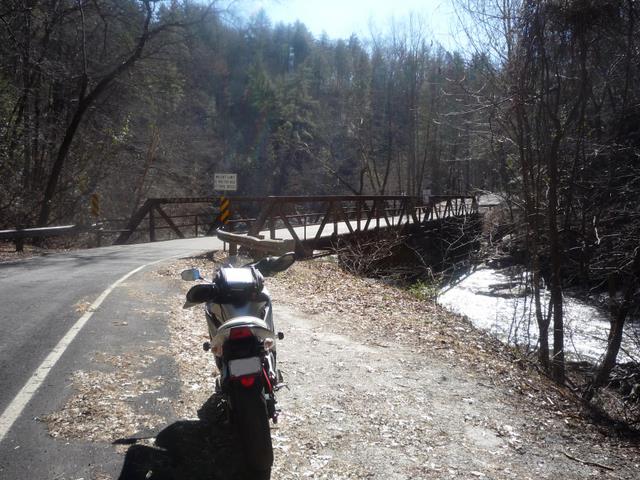
Oh, here's the new tag I posted.  See if you can find it. 

Clues:
"This bridge spans a small river.
The river has something to do with twelve miles, and it must be tired -- as it needs to lay.
The bridge is not far from woodside two.
If you go further on the road you will find Elfwing and Magic Mountain, both centrally located."


If you go:

.

 .