Showing posts with label tumble. Show all posts

Friday, June 9, 2017

Don't Hit It, Unless You Can Eat It All....

.
Well, that's an odd title for a posting. 

I am not suggesting that you eat anything you hit when out riding the scooter. 

Nor am I advocating that you try to hit anything that happens to be on the road.  I'm afraid that PETA or some other bleeding heart group would come after me if I did. 

I'll explain further in a bit. 

What brought this strange topic to mind was a trip I took the other day, where a stray dog was standing on the road.  Confused as he could be, he was not sure where to turn. 

Here he is:


After slowing way down and blowing the horn at him a lot, he ran off. 

A closer look:


He is not long for this world, I'm afraid, if he stays around here. 


That got me to thinking.  What if I had hit him?  He is probably an 80 or 90 pound animal.  My bike, with me on it, weighs about 620 pounds.  He would make quite an impact if I hit him.  I am sure I would fall if I did, and I'll bet the bike would be heavily damaged both by the impact with the animal and with the road. 

...and that doesn't count what might happen to Bucky. 

So, what size isn't too big to cause major trouble if we collided? 

Let's go down the list and see if we can figure this out. 

I once ran across this horse wandering on the road, along with a pretty big dog. 

See: Stuff in the Road
Both are too big to survive tangling with on two wheels. 

This deer is also too big, even though she is a small one as deer go in this area:

See: Oh, Deer
What about this group?:

See: Got My Goat
Too big, and there being several of them together would make them hard to miss. 

Do you see the cow on the right there? 


It looks as though he is getting ready to sprint out into the street.  (Actually, he is a yard ornament in the city of Brevard, NC. ) 

Nevertheless, he is too big.  

How about this rabbit?:


You might be able to stay up if you hit him.  ...but it would be best of it were not while leaning into a curve. 

Same with this guy:


I can't tell you how many of these I have run over in the car because of their indecisiveness.  They seem to change their minds right when they have escaped being crushed. 


Yea, that's about right, I'd say.  I wish they would take decision-making classes or something. You'd think the indecisive ones would already be wiped out.  Maybe they are all that way. 

This is a slippery one:

See: Stuff in the Road
A tortoise (not a turtle).  Stay away. 

This?:

See: Pavement Surfaces and Other Things to Watch Out For
Possibly. 

So what is the decision point?  How big is too big? 


One rule of thumb I have heard,
but not tested,

is that if it is too big to eat in one sitting,

avoid hitting it.  


Your results may vary.  ...and it depends on your lean angle, your machine, your tires, your speed, and whether you manage to hit whatever it is squarely or a glancing blow. 

Lots of "depends ons". 

That rule of thumb might work for all but the tortoise.  I believe I could eat one of those in one sitting, but it sure would be quite a lump to run over.  I think I will avoid it. 


Best not to hit any of these varmints, actually. 


Instead, learn to brake heavily and swerve smartly (but not both at the same time, please).  ...and practice those moves frequently. 


There are a few other live road hazards I have experience with. 

One like this got me about four years ago: 

See: Big Bird
I avoided several of his associates who were dining on some road kill, but this one flew right into my face shield as he flew away.  Good thing I has wearing that protective gear.  (I always do, by the way.) 

What about these varmints?:

See: Stuff in the Road
...or this one?:

Especially if he is running in the middle of the road, or not facing traffic.

Some of them seem to willfully make it hard to avoid them.  ...and they have lawyers, I'm told. 

I've seen a lot of these, too:

See: Smooth
Coming and going at high speeds, some more careful than others, and some easier to avoid than others. 

They're too big, and can cause you lots of other trouble. 


So let's run down the list, and whether it is likely to be OK if you hit one:
  • Rabbit - OK
  • Squirrel - OK
  • Bird - OK (if small enough to eat in one sitting)
  • Snake - OK
    .
  • Dog - not OK
  • Goat - not OK
  • Deer - not OK
  • Horse - not OK
  • Cow - not OK 
  • Tortoise - not OK (usually small enough, but hard and slippery)
  • Man - not OK
  • Bicyclists - not OK
  • Motorcyclists - not OK
Well, it looks as though the list is pretty long of things that you should avoid hitting.  That's a good policy. 


What about you?  What animals have you encountered on the road...and what was the result? 

.
.
.

Thursday, August 7, 2014

Identify Yourself!

.
When you are out enjoying the roads and the fellowship of riding on two wheels, there are a couple of things that you ought to have with you just in case. 

We discussed one of these a while back -- taking a coach's whistle in case you are so unfortunate as to run off the straight and narrow -- or off the twisties -- and into somewhere you can't be seen.  You might be able to give some blasts on the whistle and attract attention to your plight.  It could save your life, even. 

Another thing you should do is carry some identification.  Yes, you have to carry your license and some dinero to buy gas and lunch victuals, but I don't have room in my riding suit to carry my entire wallet.  It has too much other stuff in it -- and it is not all cash, by the way.  I do stuff the important items into a Ziploc® bag and put them into my breast pocket.

I have heard stories, though, where a rider who has met with disaster on the road has to be taken out of, or even cut out of his protective gear (you do ride in ATGATT, right?), and the gear gets separated from the rider.

That's bad.

The emergency people ask: Who is this unfortunate soul?  How do we know who to tell that we had to scoop him up and carry him off? 

So, it seems to me important to do two more things. 

This first of these is where my brilliant idea comes in: Carry a comprehensive identification tag around your neck.

Like this one: 

The tag is printed on both sides with the pertinent info, then laminated in plastic to keep my copious sweat from making it all soggy, and it is attached to a stretchy lanyard from an old pair of earplugs.  (You don't want to make the cord too substantial, lest it choke you if you get it caught on something.)  

The info on the tag should include, at minimum:

  • Your name and street address
  • Your wife's name, street address, and phone numbers
  • Your children's and/or parents' names and phone numbers
  • Your employer's name, address, and phone number
  • Your wife's employer's name, address, and phone number
  • Your medical insurance provider, identification numbers, and phone numbers
  • Your auto insurance provider, identification numbers, and phone numbers
  • Your personal physician's name and phone number
  • Your allergies
  • Your medication types and dosages
  • Your blood type
  • Any diseases or medical conditions you have
  • Names and phone numbers of emergency contacts, if different from above
Make the typeface small enough to fit all the vitals on, but make sure it is still legible.  The paper part on mine is 2-3/8" high by 2" wide.  You can buy self-stick lamination sheets if you don't have access to a heat laminator. 

The last very important thing is to make certain that the people who are listed as emergency contacts know to answer the phone, even if they don't recognize the number calling them.  I have been out on a ride where we needed to get in touch, but where the contact did not answer the unrecognized phone calling.

Also bad.  

If you ever need it, these things could save your bacon.  Make a tag today, and wear it whenever you go out riding, or do any other activity where somebody might need to have some essential information if you can't tell them yourself.  


References:

Thursday, August 1, 2013

Not Whistling Dixie

.
Know what this is? 
.


Well, yes it is a coach's whistle, but it is far more.

It could be a life saver. 

How?  If you keep one of these on a lanyard around your neck, you have a way to signal somebody if you aren't in plain view.  Like if you have run off the road into a thicket, or tumbled down an embankment.

Not pleasant to think about, but it could happen.  And if it does, it could be vital to your survival. 

That little item can give a loud-and-clear signal with even a light breath. Even if you can't speak or holler. 

It works for hiking and bicycling, too.  I have carried one for several years now.  Fortunately, I have never had to use it. 

And that's not just whistling Dixie


Links to related postings:
Let Somebody Know -- and Give Them This Critical Instruction 
.
.

.

Friday, July 1, 2011

Let Somebody Know -- and Give Them This Critical Instruction

.
When out riding, it is always a good idea to let someone know where you are going and for how long.  That way, if you are significantly delayed without word from you, they can send out the search party.

It is also a good idea to give your contact information to fellow riders in a group.  If you get separated, or one has a mishap, you may be able to contact the others to let them know what is going on.

Beyond that, when riding with others, exchanging names and phone numbers of their families is a good idea, so they can be contacted, especially if there is an emergency. 


On that last item, there is an important detail that must be completed by all riders beforehand.

Ready?  Here is the critical detail: 

Make CERTAIN that whomever
is at home while you are out,

answers the phone,

EVEN IF they do not recognize the
caller's telephone number.
 
.

I have had some first-hand experience with this.  I arranged to meet up with a fellow rider, and we diligently exchanged our contact info, including our emergency contact phone numbers.  He had the misfortune of running off the road and into a guardrail during our ride.  He was wearing full gear (Haven't I heard somewhere about that being an excellent idea?), but needed a trip to the hospital to patch up his injuries. 

I pulled out my cell phone to make a call for help, but there was no service.  Some others had stopped to help, but their phones were also without service.  One of them drove to a place where he could make the 911 call for help.  Once the help arrived, I found a place where I could just barely get cell service, and called my buddy's emergency number.

I got no answer. 

His emergency contact did not make it a practice of answering calls from unknown numbers.  In this day and age of prank callers and unwelcome solicitations, that isn't unusual.  However, as a result that day, it was about an hour later that his family was notified of the accident.

I had never given a thought about instructing my emergency contact to answer the phone -- no matter what -- while I am out riding. 

I have now.  How about you?
.

 .

Thursday, January 6, 2011

Leather Cleaning -- at Home!

.
Now that winter has set in on most of us, it is a good time to consider cleaning up the bike and accessories for spring riding. One of those accessories is your riding outfit. You do wear more than just a pair of jeans and a fashion jacket, right?  I'm not talking about those.  I'm talking about real motorcycle protective gear. 

I always ride in a leather suit, but my suits are not new ones.  I have scrounged them from pawn shops and on-line auction sites, so they were not all pristine when I got them.  In addition, I have put on about 23,000 miles in the three years I have been riding, so the suits have seen year-round conditions including rain, road dirt, bug splats, ...and an unexpected taste of mud on the berm of a road. 

Here is an article I wrote about cleaning leather at home that appeared in a local Greenville South Carolina magazine called Motorcycle Lifestyle.  The magazine publisher, Norm Blore, is an accomplished motorcyclist and graphic artist.  His magazine was one of my favorites, but, alas, it succumbed due to a lack of advertisers in the flagging economy, though a few issues can still be seen online at the link above. 

Edit October 2012: The recommended washing product Woolite for All Colors is apparently no longer available.  Use instead the Leather Therapy products referred to later in the article.  

----------------------------------------------------------------------------------

Cleaning Leather Motorcycle Apparel at Home
By: Bucky 
Disclaimer: Users of this procedure do so at their own risk. Neither the author nor this magazine is responsible for any loss suffered in connection with its use. 

Cleaning of leather riding apparel is needed from time to time to remove the inevitable bug splats, road soil, perspiration salts, and the results of an occasional tumble from the machine.  
Upon searching for sources of cleaning services, it was found that they can be expensive, and that some local cleaners may not have experience with multi-colored leathers.  Therefore, those with limited funds or who lack a nearby cleaning source search for alternatives.  A few on-line sources suggest that washing at home can be done, so being frugal, this rider/writer had to try it. 

So far, three suits have been cleaned using this method, all with good results.  The suit documented here is a white Fieldsheer one-piece that is about 15 years old.  The other suits were a very bug-splatted and sweat-salt-encrusted Polo black/yellow two-piece and a Fieldsheer light gray/dark gray/black two-piece that had gone through a tumble.  
The white suit that is the subject of this article has been down once onto a mostly grassy berm, mud soiling and scarring a few places on it, as shown in the photographs.  The suit also had some minor soiling in the crook of the arms, and dark areas where the inside of the black riding boots touch the lower legs.  


The washing method used is detailed here: 
Test for Colorfastness
Use a dampened white towel edge to gently rub each color in the garment.  If there is little or no transfer of color to the towel and if there is no noticeable loss of color on the garment, this indicates that the quality of the leather components is high enough to allow wetting while cleaning.  

Products Needed
Woolite For All Colors Fabric Wash. 

Lexol Leather Conditioner, Preservative. 


Padded hanger for drying.  Slitting a foam plastic swimming noodle and slipping it over a sturdy wooden coat hanger is an inexpensive way to make such a hanger.  A noodle with a hole down the center works best.  Make sure the ends of the noodle cover the wooden coat hanger and that the noodle extends slightly into the sleeves of the garment.    


Washing Equipment and Settings
Domestic washing machine with as large a capacity as possible.  Either top or front-loading type is acceptable.  A top-loading extra-large capacity washer was used for this suit.
Set the water level to maximum.
Set the temperature for cold wash and cold rinse.
Set the agitation and spin speeds to delicate or slow.

Pre-Washing Procedure
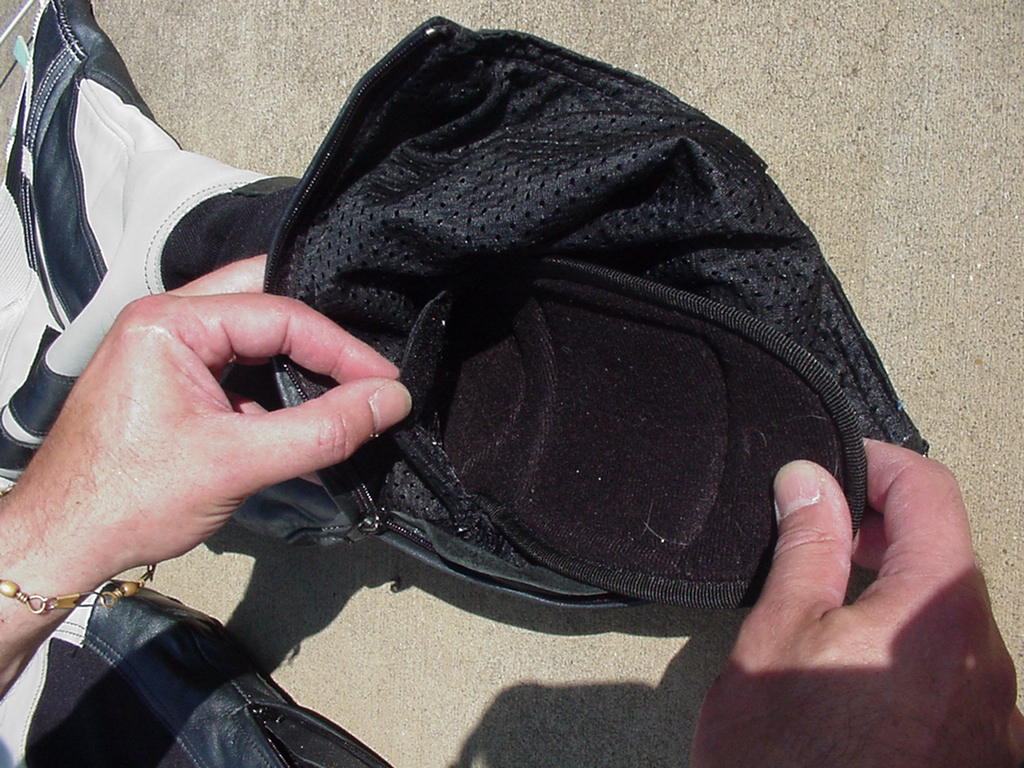
Remove all armor and padding that is removable.  These are usually fitted into pockets in the garment’s lining whose openings are closed with Velcro.  Sometimes the armor is accessible in pockets from the exterior of the suit. 
Remove knee pucks. 
If the garment is very dirty with mud or bug splats, hang it where it can be rinsed with a garden hose.
Spray the garment with the hose until it is saturated.
Use a clean sponge and a soft bristle brush to remove dirt from the surface, from the stitching, and from the seams.
Rinse thoroughly.
Immediately begin the Washing Procedure below without allowing the garment to dry.


Washing Procedure
Turn the garment inside out to protect the leather from the washing machine agitator and from zipper abrasions.  Close all zippers and Velcro.
Partially fill the washing machine tub.  

Add 4 oz of Woolite For All Colors Fabric Wash.  (Fill the Woolite bottle cap to the top.)  Agitate for one minute.  
Submerge the garment completely and distribute it evenly in the tub to reduce imbalance during the spin portion of cycle.
Wash only one item at a time.  

Continue to full the tub to capacity.  Set the agitation time for 12 minutes.  When that time has elapsed, but before the wash water has drained, reset the washing machine timer for an additional 12 minutes.
When the second 12-minute agitation portion of the cycle is complete, allow the machine to complete its cycle.
Again set the washing machine to rinse, redistribute the garment in the tub, and allow it to fill and rinse a second time to thoroughly remove the detergent.  

Meanwhile, clean the armor with mild detergent and a sponge, and the knee pucks with a brush.  Rinse and set aside to air dry. 

Treatment After Washing
Remove the garment from tub.
Turn it right side out.  Do not wring it or stretch it excessively.  

Hang it on a wide, padded hanger to avoid stretching the garment during drying.  
Close all zippers and Velcro to help prevent the garment from stretching unevenly.  
Two-piece suits can be zipped together and hung as one or can be hung separately.  (When the pants of a two-piece suit are hung separately, the spring clips of the pants hanger may leave depressed areas in the leather.)  If the garment is too heavy to hang, lay it flat on several bath towels.
While still wet from washing, apply Lexol Leather Conditioner, Preservative by spraying or wiping it on with a clean sponge.  The conditioner should be applied until is just begins to run.  

Use a clean cloth or sponge to smooth out runs, as these may cause streaking once the garment is dry.  Straighten out the garment so it has as few folds in it as possible.  Straighten the zipper flaps so they dry flat as well.  


Drying
Allow to air dry on the hanger in a heated or air conditioned room.  Do not dry near direct heat or in the sun.  A circulating fan is helpful in speeding drying, especially when the humidity is high.  

Occasionally, shake or “pat” the leather to manipulate the leather fibers and promote flexibility.  
If laying flat to dry, turn the garment over frequently and exchange the bath towels for dry ones to allow all portions to dry.  
The suit in this article took about four days to dry while hanging in an air-conditioned room with free air circulating around it. 


Afterward
Once dry, again treat with Lexol Leather Conditioner, Preservative.  Wipe off any excess.  

Allow garment to further dry for a day or two. 


Results
The suit is, in general, clean and bright.  There is no noticeable running of the colors.
The leather is soft and supple.  

The Lexol conditioner left a waxy finish that does not seem to cause excessive slipping on a synthetic leather motorcycle saddle.  
The leather shrunk very slightly, probably to its original size.  
The suit has been worn once since the washing, and it appears to have stretched a bit during that wearing, much as new leather would be expected to do.  
The mud is almost all gone, except in some stitching and in scratches where the leather was abraded in the tumble.  
The soil in the crook of the elbows was removed.  
The marks on the lower legs from the inside of the boots were not removed by the washing process.  
The sweat salt and stiffness in the other suit washed previously was removed without a trace.  

These pictures taken after the washing process show the worst-soiled areas of the white suit.

Some of the procedures described above were recommended by the makers of Leather Therapy preparations for cleaning leather.   
Their products have not been tried by the author, though they are specially formulated for leather cleaning at home. They recommend their Leather Infusion Wash in place of the Woolite For All Colors, and their Leather Infusion Rinse afterward.  After that, use their Restorer/Conditioner if the garment seems dry.  They have posted some videos that show the procedure. 

This shady-looking biker dude is showing off the finished product.  
----------------------------------------------------------------------------------
Well, there you have it.  Now there is no excuse for wearing dirty leathers -- unless you want people to think you ride a lot.  


Oh, no.  What have I done? 


 .

Thursday, March 11, 2010

"Look Where You Want to Go" Works for Some Things Other Than Motorcycling

.
I was recently perusing websites of motorcycle riders in the Carolinas, and I found FastFred's Motorcycle Rights E-zine. In it, Fred Ruddock writes that
"This ezine covers South Carolina, southern, and national politics from a biker's [perspective]. Subscribers receive the latest motorcyclist news and alerts when politicians threaten motorcycling."
Fred's website contains a number of good articles about local attractions, product reviews, trips, and especially about legislative activity related to motorcycling. He rides a FLHT (Harley-Davidson Electra Glide Standard -- I had to look it up), and has put 175,000 miles on it since 2003, so he is far from a newbie. He sells stickers like this to support his website:


Hmmmm, I think I have heard the "Don't Tread on Me" part somewhere before, maybe in that long-ago history class where I didn't pay enough attention to the teacher.

His is not a bad thought, considering that most legislators these days don't seem to have the best interests of their constituents in mind when passing laws. To them, more government control is better. It almost never is, and it would be far better for the government to get out of the way and let freedom and free enterprise work unfettered.

Activists like Fred help prevent the politicians from running roughshod over our rights, in his case, related to motorcycling.

Anyway, Fred also kayaks, and he has written lots of reports on rivers he has run.

FastFred at Double Trouble on the Ocoee River (October 4, 2009)

He sounds as though he is quite experienced at it, and in one of his writeups, he includes something that got my attention. It is in his article called CCC [Carolina Canoe Club] Clinic Trip Report: First Descent of Ocoee and Wilson Creek.
"Upon leaving Ocoee’s small put-in eddy the Class III fun begins with ferry from river right to river left above Grumpy’s Ledge. After completing this ferry there was a long delay as one of our classmates failed to make the eddy and became separated from his boat and paddle; his paddle traveled a considerable distance before friendly boaters found it.

"During this delay I lost focus as I eddy hopped down river left; I bumped a rock in a hole but rather than look where I wanted to go I looked at the rock. This resulted in a flip in shallow water; I missed a few roll attempts as I was drug across the rocky bottom and took a short swim. Thanks to Trent’s timely assistance I was able to enter the first eddy; this was my only swim of the weekend."

Did you pick up on what he said, the part that I underlined? "...rather than look where I wanted to go I looked at the rock." He paid for his moment of lost focus by being dragged along the rocky bottom and taking a swim in turbulent waters.

Sounds as though motorcycling skills and kayaking skills run parallel.

I first learned about looking where I want to go back in the MSF Basic Rider Class, and wrote about my class experience just before I bought my Ninja. The instructor repeatedly encouraged, then admonished us if necessary, to look where we want to go. It certainly works -- you will go exactly where you are looking, whether that is a good place or bad.

I recall reading a story about an MSF instructor, Irondad, whose student had target fixated on a portable outhouse set on the edge of the class course for the day. The rider was headed straight for a collision, despite the fact that the outhouse was the only hazard around. There were unlimited opportunities to miss it, anyway. In an effort to divert the student from certain disaster, he yelled to the rider "Look at me." The rider did so, and easily missed the hazard, steering safely back toward where he was looking -- at the [I imagine red-faced, hoarse-voiced] instructor. There is no word on whether the student avoiding hitting the instructor, however. That student fixated first on a bad thing -- the outhouse, then on a good thing -- missing it.

I can relate to fixation. My own "off-road" experience is one I don't wish to repeat.

Here is a pretty good article about target fixation, both good and bad. The idea is that you don't want to fixate on what you want to miss, but rather on where you want to go to avoid the hazard. That website also has a bunch of other good articles about riding.

Here is a guy looking where he wants to go on his motorcycle.

Photo from RoadRunner Motorcycle Touring and Travel

Here is another guy doing the same, but in his kayak.

Photo from Paddling.net article by Ken Whiting

J.R. Patten, on the Hey, I'm J.R. blog, (also here) has some interesting words about kayaking:
"Quit looking at the rock. If you look at the rock, you’ll hit it. Know the rock is there, but instead of looking at it, look where it is you want to go instead. If you look where you want to go, you’ll go there, and you won’t hit the rock.
"They were right. We were concentrating so hard on the rock that we unconsciously steered the boat right for it. The harder we tried to avoid the rock, the more likely we were to run into it. Once I stopped looking at the rock and focused my attention on where I wanted to go, my skill improved dramatically, and I had a lot more fun. And I stopped running into the stuff they told us to look out for. Finally I was going where I was trying to go instead of getting stuck on obstacles."
J.R. is in his mid-twenties, but has drawn some good conclusions here:
"I think the parallels to life are pretty obvious. When you’re working at something — be it a business, school, a hobby, or a personal goal — there will be big rocks that you’ll have to avoid. The key is to not look at them, not dwell on them. If you spend your time thinking about them, you’ll run right into them. Instead, just know they’re there. You don’t want to be oblivious to them, but don’t dwell on them.

"Focus your attention on where you want to go, and you’ll stop running into the obstacles and start moving in the right direction. You’ll get a lot better at whatever it is you’re doing, and you’ll have a heck of a lot more fun, too. I guarantee it."
So, look where you want to go, whether on land or sea, or in life!
.
.

Monday, January 26, 2009

First rides ...and a mishap


Once I had the motorcycle home, I began looking it over. The fine, shiny plastic cowlings gleamed in the light, and it seemed prudent to buy a set of frame sliders in case I tipped it over. I did not want to cut the cowlings as some sliders require, so I settled on a set of Kawasaki OEM sliders. I bought them from Blue Ridge Performance [BRP], their having the best price. Gary, the owner is a bit of a character, but he has good prices on 650R parts and accessories. Once the sliders arrived, I installed them over the next couple of evenings.

I also thought it prudent to get some body armor to wear when riding. The SquidBusters Forum had advertisements for the VelocityGear Juggernaut armored shirt. It consists of a back protector, chest protector, shoulder, elbow, and forearm CE-approved armor. The back protector can be zipped off to be used separately. It was priced attractively, and there was a discount if you were a forum member. I placed the order.

...and I bought a new silver helmet, a Scorpion EXO-700.

Oh. I should tell you that for some reason, while I was waiting for the MSF Basic class weekend to roll around, I decided to grow a beard and mustache. Actually a goatee and mustache. I had not had facial hair for around thirty years, so this was out of the ordinary. Maybe I was announcing the new me -- macho, motorcycle rider, hairy faced, young (second childhood?). Who knows. Actually, that is about the time I started using the nickname Bucky, too.

The first time out riding on my own, I was very shaky. I wobbled around turns, had to remind myself to look where I wanted to go, and generally had a time of it thinking about all the things that must happen to control and maneuver a motorcycle. There was not yet any sign of muscle memory helping me coordinate everything that had to happen. At any rate, the first few rides were taxing, and unnerving, with only a little of the enjoyment and exhilaration I longed to feel. I found that running along a straight road at 45 miles an hour was scary to me.

Slowly I gained some confidence, and began to have moments of enjoyment when riding. I ventured out on the roads near our house over several days, occasionally going further away.

I learned about target fixation next. It was a hard and expensive lesson. I was on a slightly curvy road, thought I could not make a turn, looked hard at the edge of the road, and went off within an inch of where I was looking. The ditch was shallow, but my nearly-new bike was in several pieces. Some of the shiny cowlings were scarred up, and the windshield, the seat, and a few other miscellaneous things were all separate from the carcass.

I called my wife from my cell phone with the news. She became...er...somewhat excited. So there I was, having flown off a nearly new motorcycle that is laying in pieces along a considerable stretch of road, asking my wife to be calm. I talked her down. A little while later, she drove to the site and stayed there with the bike while I went to borrow the neighbor's trailer to bring the whole mess home. She diligently piled all the loose pieces up so it would be less work once I arrived with the trailer. Two of our neighbors, Wes and Randy, were very helpful and sympathetic. Thank you, kind sirs. Once home and with the carcass unloaded into the garage, Randy gently asked me if I thought I would fix it and ride again, or whether that was the end. He philosophically and quietly stated that he had seen it done both ways. ...and he left it at that. At that point, I closed the garage door and went to bed.
-->
I have dwelled on the injuries to the bike, but not the injuries to me. I must tell you that I was almost unscathed. Here is why. I vowed from the start to wear all of my protective gear whenever riding, no matter how short a distance. You remember the photo of me on the Honda Nighthawk at the MSF Basic class wearing a leather suit, boots, gloves, and helmet? That was the start of wearing all the gear, all the time [ATGATT].

When I took my tumble, I was wearing all this gear:
  1. Fieldsheer two-piece leather suit
  2. VeocityGear Juggernaut armored shirt
  3. Joe Rocket Sonic boots
  4. ICON TiMax long gloves
  5. Scorpion EXO-700 helmet
I suffered aches and pains for a few weeks afterward. Over-the-counter painkillers made it tolerable. Without the gear, I could have been much more seriously injured. My strong advice: NEVER, EVER ride in anything but full gear. Anyway, I think it looks cool. I can ride up with a bunch of others, and not until I remove my helmet do the bystanders realize that I am middle-aged. That makes me feel pretty good.

I already hear your excuses:
  1. It is too hot.
  2. I don't like to be all bundled up.
  3. I like to feel the wind in my hair.
  4. It is too expensive.
  5. Nobody else wears it.
Answers:
  1. Wait until you feel the burning when they take skin grafts from your back/chest/head/thigh.
  2. Wait until they start to pick the gravel out of your hide.
  3. You might not have a skull, let alone hair, if you fall on your head...or you might be a vegetable.
  4. How much does one emergency room visit cost? And the lost wages away from the job?
  5. Everybody who is serious and practical wears the gear.
Look at these, if you can bear to do so, to see the effects of a tumble from a motorcycle:
So, I learned that target fixation works perfectly. The experts are correct: Your bike will go where you look!

It took me quite a while to get over the psychological trauma of my tumble. I had lost quite a bit of confidence in myself. I could not bear to tell my coworkers what had happened. Once I got over the initial despair, I started to determine how to make the bike rideable again. It turned out that it was good therapy to find parts and figure out how to put them together into a real motorcycle. A local shop, Baker's Cycle Werx, helped with some work I could not manage on my own.

Well, enough about my accident. Suffice it to say that two months and many dollars later the bike was back in one piece and almost as good as new.

I started riding to work as much as I could. There was almost nobody there who could believe that I had actually bought a motorcycle, let alone a sporty one. Even now, when I ride in, some of my work associates comment to me about my "Power Ranger" appearance as I come into the plant.

I met a grandmother at the post office last Saturday in fact, who said her four-year-old grandson riding with her in the car had spotted me riding up, and told her that I looked like a Transformer. I went over to talk with him for a few minutes about how he might be able to get a motorcycle one day but, as I knocked on my helmet, that he had to be careful with it so he didn't get hurt. Maybe the seed is planted.

I started riding further and further away from home, and I have visited some of the many sites within about 100 miles. I'll report on them in upcoming postings.

Meanwhile, here is what I usually look like when I ride, though usually without the saddle and tail bags.

Note that I am wearing ATGATT and that you can see the frame sliders.

...all color coordinated, to boot!

Pretty snazzy, don't you think?