Showing posts with label leathers. Show all posts

Thursday, September 3, 2015

Drying Out Your Leathers After a Rainy Ride

.
What happened here?  

I've fallen, and I can't get up!
This doesn't look good at all.

But don't worry.  That's not Bucky lying on the floor.  Just his suit.  


A couple of weeks ago, I went to a place called Fields of the Wood, and got caught in a rainstorm that soaked my white leather suit pretty well.

I rode about an hour and a half after the rain stopped, so it dried to some extent, but I wanted to make sure it was thoroughly dry before storing it for my next ride.

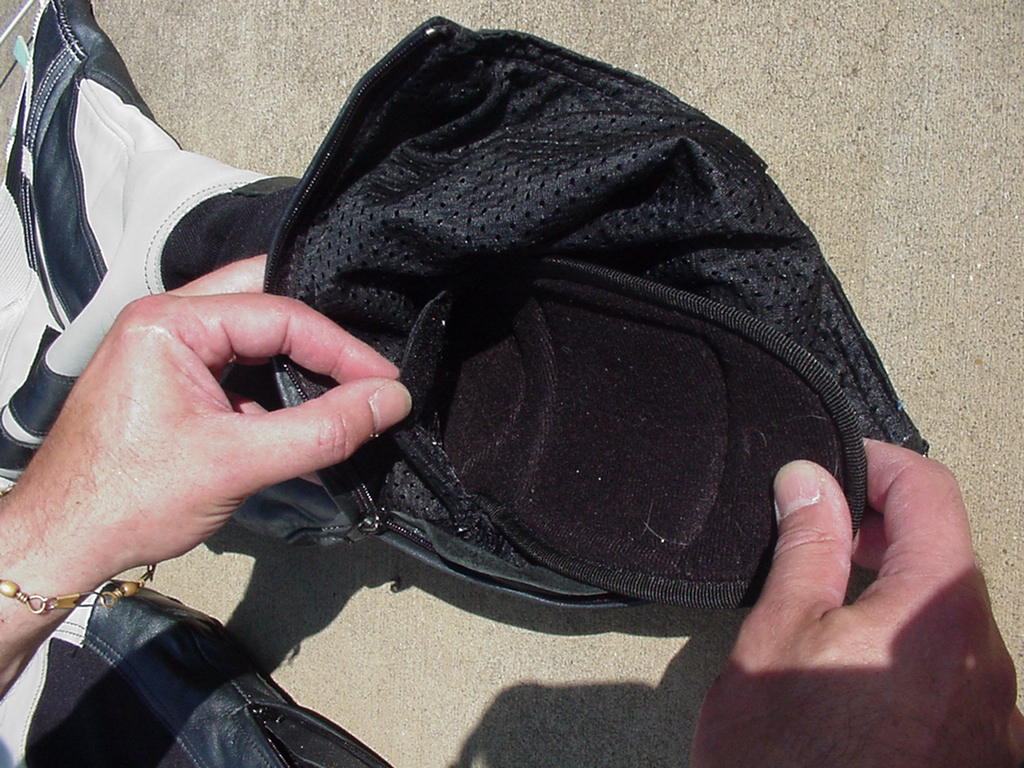
So, I laid it out on the floor with the neck over the air conditioning register, the sleeves and legs as straight as I could make them, and let the cool, dry air blow through it for a couple of hours.  Don't do this during the heating season, or your leather is likely to come out like cardboard. 

Cool
Then I hung it on a padded hanger like this one I made out of a pool noodle and a plastic hanger... 


...and let it dry the rest of the way, with an electric circulating fan blowing on it so it dried faster.  . 


Even better -- don't get your riding togs wet in the first place. 

Duh.  Why didn't I think of that? 


You could either ride when it is not supposed to rain...

...or invest in a rainsuit -- and remember to take it with you when you ride. 

On my behalf, I thought I was going to avoid the rain that day, but it rained anyway.  I have a rainsuit, but I usually don't pack it because it is rather bulky in the tank bag.

[Well, don't whine about getting your suit wet then, Bucky.] 

OK.  I'll do better.  I promise. 


By the way:

If you have gotten your leather suit wet, and it's pretty dirty, you might consider going ahead and cleaning it yourself.  Yes, you can do it yourself, right in your own home. 
.
.
.

Saturday, November 16, 2013

Old Folks, Pianos, and Bucky

.
On occasion, I like to have a little fun with my appearance as a typical motorcycle rider when I am around "normal" people. 

Now, "typical" is probably not a good way of putting it.

The usual stereotype of a bad biker is one of black chaps and a slant-zip jacket over a sleeveless shirt, with maybe a bandanna, a colors vest, a few chains, and some tattoos in conspicuous places. 

Or, it could be a kid on a too-high-powered sportbike wearing cargo shorts and a tee shirt, perhaps with a back protector over the tee (for safety). 

How about that Gold Wing rider with his drink holders and space enough to carry a complete closet full of clothes and a mechanic's tool chest just in case? 

Well, I have to admit that we bikers, especially the ones dressed for the road, look a little odd when we are not riding, but still in our getup around non-biker people.  On occasion, I have stopped at a take-out restaurant or other retail establishment and had folks give me the eye for the way I am dressed.  Not very many make a comment, surprisingly, and even if they do, the comments are often flippant: "'fraid of fallin' off that thing?" or "Ya' look like ya' just stepped off the Starship Enterprise."  

And, when I buy gas, I don't like to waste time taking off my gloves so I can unbuckle my helmet to go in and pay for my purchase.  So, I go in with the full regalia, credit card in hand, and fork it over to the clerk who no-doubt is wondering if I am about to rob him and take off at high speed with his money. 

There is one other situation where I have a little more fun.  You know that I play the piano, and that I tickle the ivories with mostly old popular tunes -- from the early twentieth century into the sixties.  They come from sheet music I have collected over the years, and from my mimicking some of the songs on my hoard of player piano rolls. 

I also play a lot of old-favorite hymns. 

There are several nursing and assisted living homes that periodically ask me to come and play for their residents.  After all, I may be one of the only people still playing tunes that their parents grew up with or that they, themselves enjoyed when they were young. 

I sometimes ride the bike on the days I play for them, a pack on my back filled with music books.  When I get there, it is easier to leave everything -- helmet, gloves, backpack, etc. -- on rather than try to carry it all in my arms separately.  I've done it both ways, and I usually drop something along the way if I take everything off first.

And that is where my fun begins. 

As I walk in the door and to the room with the piano, which is sometimes quite a ways away from the entrance, the residents look agape, wondering whether they are seeing things that don't really exist. 

And some are ready to defend themselves against the likes of me.

The staff of the home thinks an alien has invaded from outer space for sure, and place their hand on the phone in case they need to call in the Men in Black -- or more. 

Little kids visiting grandmas and grandpas often ask me if I am a Power Ranger. 
I am, I tell them -- the Silver one.


I think I see in the eyes of some of the men a glimmer of memories of days gone by, maybe when they rode a now-ancient motorcycle cross country on a shoestring.  Or they remember trying to impress the young ladies with their style and daring. They might be reliving that time in their past through me today. 
Students of Scott Sr. High School
Westwood, PA
I get a kick out of giving them something to talk about the next day over lunch or supper, too.  "...you know, Mabel, that young man with the odd clothes, who came and played the piano for us last night?  Well, I've never seen anything like it...." 
SuperStock photo
Often times, I banter with the audience.  I kid, and tease, or explain something interesting about the numbers I play.  I bring up the importance of God, country, and family, and the very real potential of our losing our freedoms of religion and speech if we don't pass down our values to young people. 

Sometimes I jokingly tell them that there will be rides on the back of my motorcycle after I am through playing. 

One summer evening, a spry lady actually followed me out to the bike, expecting to get her ride right then and there.  I had to explain that I could not give her a ride that night, but maybe the next time I came around.  Well, the next time I came around, about six weeks later, she asked first thing if I were going to give her the ride she missed last time!  I had to decline again, but she remembers to this day that I owe her one. 


There is something else. 

A few of the people in these places are in pretty bad shape.  Life has become less full for them.  Some are no longer the people they once were, and they might not realize as much about what is going on around them any more.  Their eyes have become dim, and their bodies frail. 

I sometimes wonder to myself whether they will really get anything out of some guy pounding on a piano. 

And I would be wrong if I thought they didn't. 

Getty Collection
It is amazing to me.  Some who appear to be quite unresponsive seem to be moved by the music.  The hymns, especially, are still familiar to them, learned long ago.  They may remember the words of every verse, and they sing along with my playing.  Despite their foggy memories of things that happened just yesterday, they still remember the old things. 

I was at first surprised by this.  Then I became moved.  I am encouraged by them.  I play my heart out for them.

And I know that I should never forget that my meager God-given talents are to be shared freely.

I hope someone comes to see me and play for me when I am long past my prime.  It might bring back a misty distant memory or two I have made. 

Do something for someone else today. You will get more out of it than you might think. 
.

Monday, November 4, 2013

New Skid Lid

.
When I started riding a motorcycle back in 2007, I was in my 5th decade of life.  I wished to prolong that as best I could, so I made sure I had the proper protective gear.  I never ride without a full leather suit, motorcycle-specific gloves and boots, and a full-face helmet.

I even wore one to the MSF beginner class I took: 


I wore this used helmet for a few weeks until I bought the new one.  It is now relegated to being a photo frame in my office.

Since my noggin a very important part of me, I looked over the reviews carefully when I bought my first helmet and found that the Scorpion EXO-700 was highly rated and reasonably priced.  I went to the local dealer and tried one on for fit.  I wore it for about 20 minutes n the store to make sure there were no pressure points.  I got some odd looks from other customers, but that is the penalty you pay to make sure you are not buying something that won't fit properly.  I decided that it was fine, so I made the purchase.

I bought light silver color because it matches well the silver on the bike, and blends with my usual riding suit colors.  

That lid now has almost 40,000 miles on it, over a little more than six years and some 536 rides.

By the way, that Fieldsheer suit was an early purchase in the quest to learn to ride a motorcycle.  I actually bought it at a pawn shop more than ten (!) years before I got a motorcycle.

What can I say?  It was a really good deal.  It was just luck that the motorcycle I bought was silver to match it. 

[How do you know all those statistics you quoted above, Bucky?]

I'm afraid I am compulsive about keeping track of when and where I ride and how far.  In fact, I can also tell you that the average ride length is 74 miles, and I have put in about 6500 miles per year, since the beginning.  That includes a lot of short jaunts to work and back, and usually just one longer ride on the weekends.  An advantage of keeping track of all this data is that I can look back and refresh my feeble memory on whether a route was a good one, what there is to see there, and whether I wrote (or might write) about it on these pages. It also helps when I am out riding to remember where any future tag game pictures were taken. 

Practical, eh? 

Now, back to the gear discussion.

They say that a helmet should be replaced when it is between five and seven years old.  Certainly the soft foam comfort padding inside deteriorates, so that is one reason to chuck it.  And it can get kind of nasty from all the sweat, even though you can remove and wash it in the Scorpion.  Indeed, my helmet had a new set of foam installed under warranty when it was three years old.  The covering over the foam had become cracked and was peeling off.  The denser protective foam is also said to deteriorate.  I don't want to find out whether it has done so by putting it to a test, so I sally forth to find a replacement helmet.

The old:


These days, my shopping is in large part on the Internet, though I almost always look locally too. 

There are so many helmet manufacturers and models to pick from, and the prices range from bargain-basement $59.95 to hundreds of dollars.  I think my head is worth more than 60 bucks, so I look a little higher. 


So, what did I pick for the replacement?  See for yourself.  Here is a picture of the new helmet in its box: 

Scorpion EXO-700! 

They give you this pretty bag to protect it:


[OK, Bucky, don't tell me...]

And here is a side-by-side photo of my old and new helmets.

[C'mon, let's see it!]

OK.  Here it is:

Yes, I admit it.  I bought the identical helmet.  Bike Bandit had them on sale for $102, so I decided to buy another one before they phase them out.  

That eye staring out of half of the face shield is intended to demonstrate its fog-proof coating.

It doesn't really work when it is cold outside.  The only thing I have found that really works to keep the shield and your glasses from fogging is the Foggy Respro neoprene insert that covers your nose and mouth.  It attaches to the inside of the helmet with Velcro.


I put my new helmet on my head to test the fit, and immediately notice the difference between it and my old helmet.  This one is TIGHT.  Has my head swelled up in just six years?

No, my original was tight too when I first got it.  In fact, if you watch your face and scalp through the face shield opening while you move the helmet, the skin should follow the helmet.  Like this.  If it doesn't, then the helmet may be too big.  You don't want it moving around. 

I hope this one gives me another 40,000 miles of safe use, and so I can continue to look snazzy with my color-coordinated look.

 [Makes us all goose bumps, Bucky.  ...NOT.]

Ride safe and wear ATGATT.

.

Thursday, January 6, 2011

Leather Cleaning -- at Home!

.
Now that winter has set in on most of us, it is a good time to consider cleaning up the bike and accessories for spring riding. One of those accessories is your riding outfit. You do wear more than just a pair of jeans and a fashion jacket, right?  I'm not talking about those.  I'm talking about real motorcycle protective gear. 

I always ride in a leather suit, but my suits are not new ones.  I have scrounged them from pawn shops and on-line auction sites, so they were not all pristine when I got them.  In addition, I have put on about 23,000 miles in the three years I have been riding, so the suits have seen year-round conditions including rain, road dirt, bug splats, ...and an unexpected taste of mud on the berm of a road. 

Here is an article I wrote about cleaning leather at home that appeared in a local Greenville South Carolina magazine called Motorcycle Lifestyle.  The magazine publisher, Norm Blore, is an accomplished motorcyclist and graphic artist.  His magazine was one of my favorites, but, alas, it succumbed due to a lack of advertisers in the flagging economy, though a few issues can still be seen online at the link above. 

Edit October 2012: The recommended washing product Woolite for All Colors is apparently no longer available.  Use instead the Leather Therapy products referred to later in the article.  

----------------------------------------------------------------------------------

Cleaning Leather Motorcycle Apparel at Home
By: Bucky 
Disclaimer: Users of this procedure do so at their own risk. Neither the author nor this magazine is responsible for any loss suffered in connection with its use. 

Cleaning of leather riding apparel is needed from time to time to remove the inevitable bug splats, road soil, perspiration salts, and the results of an occasional tumble from the machine.  
Upon searching for sources of cleaning services, it was found that they can be expensive, and that some local cleaners may not have experience with multi-colored leathers.  Therefore, those with limited funds or who lack a nearby cleaning source search for alternatives.  A few on-line sources suggest that washing at home can be done, so being frugal, this rider/writer had to try it. 

So far, three suits have been cleaned using this method, all with good results.  The suit documented here is a white Fieldsheer one-piece that is about 15 years old.  The other suits were a very bug-splatted and sweat-salt-encrusted Polo black/yellow two-piece and a Fieldsheer light gray/dark gray/black two-piece that had gone through a tumble.  
The white suit that is the subject of this article has been down once onto a mostly grassy berm, mud soiling and scarring a few places on it, as shown in the photographs.  The suit also had some minor soiling in the crook of the arms, and dark areas where the inside of the black riding boots touch the lower legs.  


The washing method used is detailed here: 
Test for Colorfastness
Use a dampened white towel edge to gently rub each color in the garment.  If there is little or no transfer of color to the towel and if there is no noticeable loss of color on the garment, this indicates that the quality of the leather components is high enough to allow wetting while cleaning.  

Products Needed
Woolite For All Colors Fabric Wash. 

Lexol Leather Conditioner, Preservative. 


Padded hanger for drying.  Slitting a foam plastic swimming noodle and slipping it over a sturdy wooden coat hanger is an inexpensive way to make such a hanger.  A noodle with a hole down the center works best.  Make sure the ends of the noodle cover the wooden coat hanger and that the noodle extends slightly into the sleeves of the garment.    


Washing Equipment and Settings
Domestic washing machine with as large a capacity as possible.  Either top or front-loading type is acceptable.  A top-loading extra-large capacity washer was used for this suit.
Set the water level to maximum.
Set the temperature for cold wash and cold rinse.
Set the agitation and spin speeds to delicate or slow.

Pre-Washing Procedure
Remove all armor and padding that is removable.  These are usually fitted into pockets in the garment’s lining whose openings are closed with Velcro.  Sometimes the armor is accessible in pockets from the exterior of the suit. 
Remove knee pucks. 
If the garment is very dirty with mud or bug splats, hang it where it can be rinsed with a garden hose.
Spray the garment with the hose until it is saturated.
Use a clean sponge and a soft bristle brush to remove dirt from the surface, from the stitching, and from the seams.
Rinse thoroughly.
Immediately begin the Washing Procedure below without allowing the garment to dry.


Washing Procedure
Turn the garment inside out to protect the leather from the washing machine agitator and from zipper abrasions.  Close all zippers and Velcro.
Partially fill the washing machine tub.  

Add 4 oz of Woolite For All Colors Fabric Wash.  (Fill the Woolite bottle cap to the top.)  Agitate for one minute.  
Submerge the garment completely and distribute it evenly in the tub to reduce imbalance during the spin portion of cycle.
Wash only one item at a time.  

Continue to full the tub to capacity.  Set the agitation time for 12 minutes.  When that time has elapsed, but before the wash water has drained, reset the washing machine timer for an additional 12 minutes.
When the second 12-minute agitation portion of the cycle is complete, allow the machine to complete its cycle.
Again set the washing machine to rinse, redistribute the garment in the tub, and allow it to fill and rinse a second time to thoroughly remove the detergent.  

Meanwhile, clean the armor with mild detergent and a sponge, and the knee pucks with a brush.  Rinse and set aside to air dry. 

Treatment After Washing
Remove the garment from tub.
Turn it right side out.  Do not wring it or stretch it excessively.  

Hang it on a wide, padded hanger to avoid stretching the garment during drying.  
Close all zippers and Velcro to help prevent the garment from stretching unevenly.  
Two-piece suits can be zipped together and hung as one or can be hung separately.  (When the pants of a two-piece suit are hung separately, the spring clips of the pants hanger may leave depressed areas in the leather.)  If the garment is too heavy to hang, lay it flat on several bath towels.
While still wet from washing, apply Lexol Leather Conditioner, Preservative by spraying or wiping it on with a clean sponge.  The conditioner should be applied until is just begins to run.  

Use a clean cloth or sponge to smooth out runs, as these may cause streaking once the garment is dry.  Straighten out the garment so it has as few folds in it as possible.  Straighten the zipper flaps so they dry flat as well.  


Drying
Allow to air dry on the hanger in a heated or air conditioned room.  Do not dry near direct heat or in the sun.  A circulating fan is helpful in speeding drying, especially when the humidity is high.  

Occasionally, shake or “pat” the leather to manipulate the leather fibers and promote flexibility.  
If laying flat to dry, turn the garment over frequently and exchange the bath towels for dry ones to allow all portions to dry.  
The suit in this article took about four days to dry while hanging in an air-conditioned room with free air circulating around it. 


Afterward
Once dry, again treat with Lexol Leather Conditioner, Preservative.  Wipe off any excess.  

Allow garment to further dry for a day or two. 


Results
The suit is, in general, clean and bright.  There is no noticeable running of the colors.
The leather is soft and supple.  

The Lexol conditioner left a waxy finish that does not seem to cause excessive slipping on a synthetic leather motorcycle saddle.  
The leather shrunk very slightly, probably to its original size.  
The suit has been worn once since the washing, and it appears to have stretched a bit during that wearing, much as new leather would be expected to do.  
The mud is almost all gone, except in some stitching and in scratches where the leather was abraded in the tumble.  
The soil in the crook of the elbows was removed.  
The marks on the lower legs from the inside of the boots were not removed by the washing process.  
The sweat salt and stiffness in the other suit washed previously was removed without a trace.  

These pictures taken after the washing process show the worst-soiled areas of the white suit.

Some of the procedures described above were recommended by the makers of Leather Therapy preparations for cleaning leather.   
Their products have not been tried by the author, though they are specially formulated for leather cleaning at home. They recommend their Leather Infusion Wash in place of the Woolite For All Colors, and their Leather Infusion Rinse afterward.  After that, use their Restorer/Conditioner if the garment seems dry.  They have posted some videos that show the procedure. 

This shady-looking biker dude is showing off the finished product.  
----------------------------------------------------------------------------------
Well, there you have it.  Now there is no excuse for wearing dirty leathers -- unless you want people to think you ride a lot.  


Oh, no.  What have I done? 


 .

Thursday, November 26, 2009

Dressing for Cold Weather Riding


.
This...

Found on AdV Rider Forum

...and this


don't occur [very often] in South Carolina.

Although it doesn't get as cold here as it does in other parts of the country, riding in the cool season requires some consideration and preparation. So far, the lower limit of riding comfort for me --skinny and cold by nature -- is about thirty-five degrees, but forty is much more bearable.

To be warm enough at forty degrees, I have come up with this list of gear, in order from inside to outside:

  • Shorts, Bicycling -- a smooth first layer with synthetic chamois for chafe reduction and padding. These are good no matter what the season.
  • Tights, Compression, Polyester/spandex -- Starter (Wal-Mart) Men's Compression Pants
  • Pant, ECWS (fleeced polypropylene military surplus)
  • Pant, windbreaker, Nylon
  • Shirt, compression, polyester/spandex, long sleeve -- Athletic Works (Wal-Mart) Men's Cold Gear Long-Sleeve
  • Shirt, ECWS (fleeced polypropylene military surplus)
  • Jacket, windbreaker, Nylon, size large to give freedom of movement
  • Shirt, armored, Velocity Gear Juggernaut
  • Jacket, windbreaker, Nylon (over the armored shirt), size extra large
  • Leather suit, Fieldsheer, 2-piece
  • Balaclava, Nylon -- Fits beneath helmet.
  • Breath guard, Foggy Respro -- This is the only device I have found that prevents fogging of both the helmet face shield and my eyeglasses. It is made of Nylon bonded to neoprene and attaches to the inside of the helmet with Velcro.
  • Helmet, Scorpion EXO-700.
  • Glove, Icon TiMax, long (look like they are from a rock star supply store, don't they?)
  • Socks, wool, heavy
  • Boots, Joe Rocket Sonic
  • Grip heaters, Trackside Delux, variable heat
This combination is fairly warm, even at speed, down to around 35 degrees. If I stop and walk, I get a bit sweaty and then become chilled when I start riding again, so when I stop, I usually open my jacket to reduce sweating. Only my hands get cold on long rides.

A tip: Don't alternate overlapping layers at the waist. Instead, put all of the shirt tails under all of the pants tops. Reason: Speed, especially when nature calls urgently. (No, I don't think it makes the bike go any faster.)

This amount of clothing is too much if the temperature is above 60 degrees. As the day warms up, I can remove a few layers, provided I have a place to put them. I almost always have my tank bag with me, so this is not much of a problem if the item I remove is compact. The Nylon windbreakers are examples.

One thing that I have occasionally done to keep warm in the cool morning hours is to add some layers that I can discard along the way as the temperature rises. I have used a plastic dry cleaner bag, and I have tried newspapers as well.


A couple of layers inside the front of my suit helps keep in the warmth a surprising amount. Once I get too hot, I stop, remove the extra layers, and go on my way without having to carry the stuff back home.

I am not the first one to use newspapers for this purpose. See this 1916 ride report of the sixteen year old Charles K. Findlay who rode an Indian motorcycle
from Montgomery Alabama to Abington Virginia via Atlanta, GA, Spartanburg, SC, Charlotte, NC, Winston-Salem, NC, Roanoke,VA and back via Knoxville, TN, Chattanooga, TN. The trip to Virginia was 859 miles and took 43 hours, 35 minutes. The return trip was 625 miles in 26 hours, 25 minutes.

Excerpt:
"I was ready to go as soon as I was dressed. I put on my riding suit [which] was already dirty and greasy, so you can imagine what I will look like at the end of the 859 miles. I cranked off at 5:20am. I was leaving Montgomery behind me. 5:45 I almost froze! I didn't know a June morning could be so cold especially in Ala. I found some of yesterdays newspapers by the road. Looked clean so I stuffed them under my coat and then rode on more comfortable."
Adventuresome lad, I'd say. Meanwhile, back to the present.

My leather suit for winter is a size 44. It fits over all these layers fairly well, but it takes a long time to get dressed and undressed --- to dress, usually about ten minutes if I have all the stuff laid out beforehand. My usual suit size is about a 40, but there is absolutely no room for any insulation in a suit of that size, despite my skinny build.

You might ask why I don't get some heated gear; say a vest or jacket liner. Well, you already know that I am frugal, so that is one reason. Another is that the alternator on my Ninja doesn't have a huge electrical surplus. A third is that should the electrical garments fail, you don't have any way to keep warm.

One thing that would help keep my hands warm is a pair of Hippo Hands. These are fleece-lined covers for the grips, controls, and hands.


They have never made a pair especially for my Ninja 650R, so I bought some on E-Bay to try. They may a bit awkward to fit to the bars, but I'll report when I try them out.

See also:
Dressing for Cold Weather Riding -- Take Two
Dressing for Cold Weather Riding -- Take Three
.