Monday, July 22, 2013

Oh, Deer

.
Remember, a few weeks ago I installed all new brake pads?  Well, they need to be broken in for maximum braking and for maximum consistency.  I recently went on that long weekend trip, and got them well broken in on a variety of roads and many braking situations.

Meanwhile, I am still getting a good feel for their stopping ability.  One way I do this is by doing maximum-effort stops without skidding a tire.  I am not yet certain just how much maximum effort is, but I keep probing to try to define it on my bike.

I was doing that on the way back from my trip on a road with no traffic behind me.  I had done four or five practice stops from around 55 miles per hour, and felt as though I was gaining a little bit of that feel for their stopping power.

I had just about decided that I was done with the braking practice for the day, so I could just enjoy the rest of the trip home. 

That is when I spotted something. 

In the road. 

Brown.  

At 10:30 in the morning. 

In full daylight.

A deer. 

Standing in the road.
(Not this deer.)

I applied my brakes gently for a second, then firmly, as I had been practicing, coming to a stop while edging over to the side of the road in case another vehicle came up behind me and didn't see me or couldn't stop as rapidly.

About that time, another deer came from the embankment on the other side of the road and they both paused for a bit, then bounded off to my right and disappeared into the undergrowth.  

David Hough, in his book Proficient Motorcycling: The Ultimate Guide to Riding Well, recommends that you come to a stop when animals are in or near the road because they are so unpredictable. That seems like good advice to me. 

It wasn't a close call, but could have been if I had not aggressively slowed to a stop.  I am glad I had been practicing.  ...and the brakes were certainly warmed up for that stop! 

The lesson: It pays to practice your technique.  You never know when an animal of one kind or another might cross your path.  This time, I needed to use one of the techniques right after some practice.
.

.

Friday, July 12, 2013

Mirror Image

.
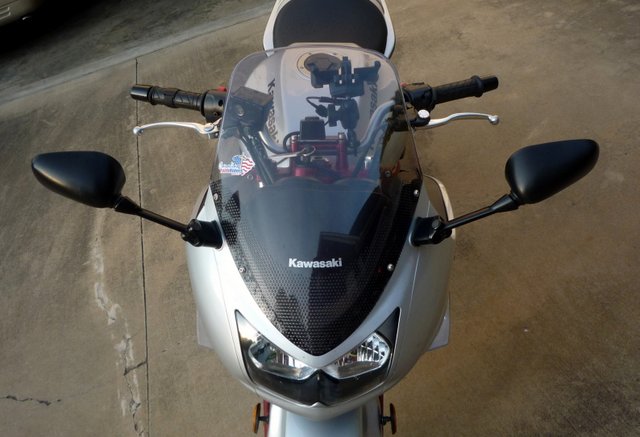
For any of you who ride a sportbike, the rear view mirrors are many times not very effective.  My Kawasaki Ninja 650R has this problem: I can see my arms pretty well, up close on the sides, and a little of what is behind me, but that is not really sufficient. 

There are a few fixes to this problem, including installing mirrors on the controls like a Kawasaki Versys,

adding a bar-end mirror,

putting in a hinge extender available from Twisted Throttle,
or putting a spacer between the factory mirror mounting location and the mirror base. 

The stalks of the first option may be effective, but they don't look so good on a sportier bike, and they would interfere with my Hippo Hands or the Ducks Unlimited hand warmers  The bar-end mirrors might be better, but the Hippo Hands are similarly in the way, and the bar weights would have to be turned down or removed to mount this style mirror.  The hinge extender works well, but it costs north of $70.00. 

I chose the last alternative, the spacer at the base, because it preserves the original look and costs less, at around $43 including shipping.  

I looked through ebay to see what I could find.  Seller rrbarna in Canada lists spacers for several bikes, one of which is the 650R.  Buy-it-now set the transaction in motion.  Gotta love ebay. 

A little while later, I received an e-mail saying they were out of stock in the U.S., but that they would send them from their manufacturing facility in Hungary.  Yes, Hungary, over there in the former eastern Europe.  I had concerns.  Despite the shipping distance, they arrived in about a week.

The spacers are nicely CNC machined from solid black, hard, slippery plastic.  The color matches the mirrors nicely.  They come with four stainless steel extension studs, so the original nuts can secure them to the instrument stay from beneath the cowlings.

Although there were no instructions, I managed to figure out how to put them on.  That engineering degree has come in handy a number of times, now! 

The most direct route to reach the nuts would be to remove the windscreen, the instrument surround, and some other plastic.  Instead, I elected to try to reach up under the cowlings above the front wheel with my 1/4" ratchet and 10mm deep socket.  I had to do this by Braille because you cannot see the nuts from anywhere I could find down there.  Also, you have to be ambidextrous, since you must reach in with your right arm to reach the right mirror and the opposite for the left. 

After some fumbling, I was able to get the mirrors off.  I threaded the extension studs onto the existing ones and tightened them snugly.  Then I slipped the plastic spacers over the studs, matching the contour of the spacer to that of the base of the mirror, and reversed the removal process to reattach them.

The mirrors will be spaced out 1-3/8" further than stock. 


This was easier said than done.  Working blind, and trying to thread the nuts onto the studs was a challenge.  Nevertheless, the method worked and I lived to tell about it, with some cuts and abrasions and a little dirt to mark my battle. 
Don't worry, I'll live. The sacrifices we make for our scooters! 

The finished product, just before a test ride. 

Proper adjustment of the mirrors on a bike is vital.  It is not as important to see directly behind you as it is to see vehicles to the sides.  Of course, lane changing relies both on the image in the mirrors and on a head check.  Scanning for other traffic is also critical so you can react should there be a need.  This includes behind us, to the sides, as well as in front.

I have my mirrors set so I can just barely see the bar-end weights in the lower inside corner of the mirrors for reference.  The rest of the view is of the adjacent road.  I also position them so they are not pointing down at the road or up into the sky.  This gives me a wider view of what is going on behind me. 

A head check (looking to the side and partially behind you by turning your head) is difficult to perform for some people, and you must look rather than use your peripheral vision to check what is around you or where you are about to go.  One trick I have learned is to swing my head down and toward the rear.  That technique gives me more visible area directly behind me.  I also find this method faster and easier on the neck, and reduces the need to twist the shoulders and the resulting effect on the handlebar position. 

When I first got this bike, I was surprised to find that the rear view mirrors are convex, giving a wider view, but making the objects in the mirrors seem closer than they actually are.  I couldn't find any reference to this fact in the literature I received with the bike. 

[Well, how's the mirror image, Bucky?] 

Oh, yes.  I took a short ride to get the mirrors adjusted properly, and I think the mirror extenders are a good solution to the limited view offered by the original Ninja 650R mirrors.  I can now see further behind me to the sides, so that the mirrors, plus head checking, plus peripheral vision covers all of the area I should see.  It is much better than before. 

What is your solution to this issue?
.

 .

Wednesday, July 3, 2013

Motorcycles and Freedom

.
I found out something recently.  It relates to our freedom -- and to motorcycles in a small way.

What have I discovered?  That my bride's father, who served in the Navy in World War II, rode a motorcycle while serving in a far-away land.  He is one of so many who sacrificed to win the war in the Pacific.

During his earthly days, he spoke little about his time of service, but piecing together some information from his bride and from others, and his notes on a few old photographs, it turns out that he saw action between 1944 and 1946.  Recall that the United States was drawn into the war in the Pacific on December 7, 1941 when the Japanese bombed Pearl Harbor, and ended on August 14, 1945, when the Japanese Empire formally surrendered.  

Born in 1926, my father-in-law graduated high school in 1944.  He entered the Navy in mid-1944.  He wanted to serve in Underwater Demolition, but his family and girl friend -- later his wife -- talked him out of it, along with his eyesight that wasn't good enough to meet the standard.  Instead, he trained for a Naval Advanced Base Unit (NABU) at Naval Training Station Great Lakes, joining NABU-12.  The NABU was designed to set up mobile and fixed bases in the event of major landing operations within, and beyond, the territorial United States. 

He landed, under fire, on the third largest island in the world, Borneo, near the town of Balikpapan.  The battle there took place in July of 1945. 

View Larger Map

As a heavy equipment operator, he helped prepare the island base.


He also buried the enemy dead to prevent disease, an unspeakable duty of his job.

The island was in the wet, sweltering tropics.   

Christmas of 1945 was spent there.

Among the Navy equipment they had there, was this 27-foot motor launch with a V-8 engine in it. 
He seemed particularly interested in that big engine.

The motorcycle I spoke of earlier was a BSA M20, probably manufactured in the last half of the 1930s, though he identified it as a 1929 model on his photographs.  The M20 was not manufactured that early, so he was probably mistaken.  Here is a video describing the M20. 

That is Dad sitting on the tank in front. 

Here is the same bike, ridden by another young sailor. The bike was said to have been nicked -- maybe borrowed -- from the Australian military personnel on the island. 
Looks like a great way to travel on wonderful roads -- not!  I suppose that it provided some basic transportation, and a little fun along with it. 

And here is another bike with a sidecar.  This one is a Harley-Davidson, judging by its front suspension. 

When troops left the island in 1946,they destroyed any equipment they were not taking with them.  Among this was that motor launch with the big V-8 engine Dad liked so much.  He spoke many years later about hating to see it scuttled. 

The natives here posed for the camera.  Dad related that the women of the island tended to be bare-chested most of the time, so the service men gave them tee shirts to wear. 
Caution: Adult content
However, for convenience, the ladies cut openings in the tee shirts in strategic places.  (Not shown here.) 

Despite the horror of war, there was humor.  Amongst the items in Dad's photo album was this:

Thank you Dad for helping ensure our freedom and making the world a safer place. 

That precious and hard-won freedom forged by the blood and sacrifice of soldiers like Dad is being lost now, squandered away by traitorous politicians.  May God keep His hand on our country, as He has since its founding, and not forsake us to our evils ways. 


More on Pearl Harbor:

Monday, June 24, 2013

Rally to Ridgecrest, 2013 -- Days 3 and 4

.
Sunday.

The day begins with devotions and breakfast -- again a great start. 

Today, we are going to ride to the Western Carolina State Veterans Cemetery over in Black Mountain to pay respects to the dead soldiers who lie there, and to their comrades in arms who have been and are still at work defending our country.

There is light drizzle, but everyone lines up at the exit of the conference center to begin the short ride there.  
That white trailer has a peculiar emblem on it.  Hotpoint -- like the refrigerator. It certainly looks the part. 

The riders make their way to the cemetery, park along its roads, and quietly walk up to the building where a few words of dedication will be spoken. 
Photo by Rally to Ridgecrest

A bagpiper plays.  A commemorative wreath is there. 
Photo by Rally to Ridgecrest

The dead lie silently in their simply-marked graves. 
Photo by Rally to Ridgecrest

Flags have been set in place on each one. 
Photo by Rally to Ridgecrest

We hear the speaker's words, then fan out to the graves.  I am touched by the solemnity of the place, and well up with the thoughts of the sacrifices these people made for my freedom.

We head back to the Conference Center as a group for another singing and message. 

I have plans to ride solo today.  My route is back up NC-80, then onto the Parkway, to and beyond Little Switzerland, then return by way of NC-226 -- a route that is twisty in several places:  

View Larger Map of Planned Sunday Day Ride to Little Switzerland

It is only around seventy-five miles, but the rain is gone, it has turned into a beautiful day, and I am eager to set out.

When I reach NC-80, I retrace my path, now toward the north instead of the south as it was on Friday.  I am not going for a speed record, but I ride along at a good clip.  The twists become tighter nearer the Parkway, and I cruise past Blind Kenny again, and they snap a few more pictures, this being one of them.
Still a pretty good lean angle, body upright, looking through the curve.

I reach the Parkway in another couple of minutes and head north.  I am enjoying the road a lot, and there is little traffic, despite it being a holiday weekend.  When I reach NC-226A, I am tempted to take it instead of 226.  It is far more twisty, though and I want to have a little less technical ride today.  So I continue on -- but I don't turn south on 226 as planned.  Instead, I continue on the Parkway until I reach the town of Linville Falls,

View Larger Map of Actual Sunday Ride Route

That adds around twenty miles to the trip, but I just don't want to leave the Parkway.

On the way toward Linville Falls, at milepost 329, I stop at Altapass and the overlook with a sign describing the Clinchfield Railroad Loops -- another series of railroad loops to allow it to gain altitude like the Old Fort Loops.
That is the explanatory sign for an engineering feat.  This series of loops, begun in 1905, and completed in 1908, is now part of the CSX system.  There are eighteen tunnels in this 13-mile trackage section, needed to overcome the elevation change of the Blue Ridge Escarpment.  The distance is only about four miles as the crow flies.  The ridge was a formidable barrier here just as it was near Ridgecrest and Saluda.  Mostly Russian, German, and Italian immigrants provided the labor for this project. 

Here is a map of the railroad route: 
You can't see much of the route from the overlook, but the Frograil railfan website has a good description of it. (Search for "Clinchfield Loops Overview.")  That site does not have many pictures, but is intended to document the best places to view the track and the trains running on it.  You can experience a simulated a trip up the loops in this video.

There is an apple orchard here also, called the Orchard at Altapass, of all things.


There is a gravel road, Peppers Creek, that leads to one of the loops, called Camp 2, at Pushpin B below:

View Larger Map of the Clinchfield Loop on Peppers Creek Road

The orchard is at the left in the map above. (Interestingly, as I was preparing this posting, I explored the map near Altapass and there is a Wal-Mart only 2-1/2 miles from the orchard!  ...and I thought I was in the middle of nowhere.) 

The distance from the Parkway to the railroad is only about a mile, downgrade, with some washboard, and loose gravel.  The road skirts the tracks south of where they pass under the Parkway, though the underbrush conceals them from view. 

I am surprised when I reach the grade crossing.  It has electric signal lights.  I stop for a few minutes, hoping for a train to come along, but, alas, one does not.  I head back up the hill, under the Parkway, and onto it. 

After I gas up at Linville Falls, I reluctantly turn around and head toward 226, turn south, and hit some curves coming down from the Parkway.  After a few miles, the road calms down, and I cruise along in the beautiful afternoon sun. 

That evening, I go to supper and to another worship service.

I take a few minutes to survey the crowd.  Many are dressed in jeans and tee shirts, and about half have leather colors vests on.  Those vests have a variety of patches and pins on them, denoting their beliefs, and some of their activities.  Here are a few:


Afterward, I attend another seminar, this one lead by Ed Obaugh, the same guy who taught Protect Yourself in Court a couple of days ago.  This one is entitled How to Share Jesus Without Fear.  Again Ed speaks from the heart and gives ideas on how to approach others in all kinds of unusual situations about their salvation through Jesus Christ.  A key point is that you don't convict a person to believe.  Rather, the Holy Spirit prepares, and you are His voice and face.  Awesome responsibility, not to be shirked. 

I spend some time in the hamburger shop, talking with other bikers.  There are fewer people here tonight because many have already departed for home, but I plan to stay another night so I will be fresh for the ride home tomorrow.

Another couple, Johnny and Lisa, will be riding in the same direction toward home on their Harleys, so they ask to come along with me.  No problem. 

I pack up my saddle and tail bags as best I can.  I have purchased a few books from the LifeWay store, so I have a bit of a challenge to get everything in, and get the zippers closed.  I prepare my paper map for the trip home tomorrow, and zip it into the top of my tank bag where I can refer to it.  The GPS is programmed to that route as well, so I should be able to follow its lead and get there just fine. 

I hit the sack giving thanks for a safe, inspirational, and enjoyable day. 

Mileage on Sunday = 153


Monday

Today, it is breakfast, loading the bike, and a last trip to the office to check out.  Johnny and Lisa are doing the same, and I move my bike to where theirs are parked.  We start out on the superslab.  I have to remember as the leader of the group not to accelerate to cruising speed too soon, as that would require them to exceed the speed limit to catch up.  Once they are close behind, I crank it up to the speed limit. 

The route I have picked is a way to get home quickly, but with a short interlude on the Parkway to give us one last period of enjoying its beauty.  Here it is:

View Larger Map of the Trip Home

It starts out on I-40/US-70, then switches to the Parkway, then to I-26, US-25, SC-11, to Easley, and home   I reach there at about 10:30 in the morning, quite a bit earlier than I expected. 


Mileage on Monday = 97
Total mileage for the trip = 588.

It has been a great long weekend, but I am ready to be home, get reacquainted with my wife, and sleep in my own bed again. 


After I returned home, I hung up my riding suit, rested for a little while, had a lunch prepared by my sweet wife, then cleaned up the bike.  There was a considerable amount of road dirt and splatted bugs to remove.  It came out pretty well, I think, no worse for wear. 

Hope you have enjoyed the trip this year.  Next year, ride along with me to the Rally to Ridgecrest.

Links to other websites:
A Weekend in the Loops of Western North Carolina
The Clinchfield Loops from the Bridghunter website
The Clinchfield Loops from the American-Rail website 
Videos of trains at Altapass, Clicnchfield Loops


Links to related postings:

Rally to Ridgecrest, 2013 -- Day 1
Rally to Ridgecrest, 2013 -- Day 2
Rally to Ridgecrest, 2013 -- Days 3 and 4

Freedom is Never Free! -- Rally to Ridgecrest, 2011, Part I
Freedom is Never Free! -- Rally to Ridgecrest, 2011, Part II

Rally to Ridgecrest Facebook Page

Memorial Day 2010 Weekend Rally
Memorial Day 2010 Weekend Rally, Part II, The Ride Up
Memorial Day 2010 Weekend Rally, Part III, Saturday
Memorial Day 2010 Weekend Rally, Part IV, Sunday and the Ride Home.

 .
.

Sunday, June 16, 2013

Rally to Ridgecrest, 2013 -- Day 2

.
Saturday.

I wake up early and go to a morning devotion lead by a fellow they call Padre.  He is a long-time employee of LifeWay, the owners of Ridgecrest.  He is a well-spoken man, who has a knack for clearly tying scripture to real life.  He urges us to tithe our time.  By this he means that we should take 10% -- the Biblical tithe -- of our time getting ready for the day's activities to devote to God.  If it takes an hour to prepare for the day, take 10% -- 6 minutes -- to study God's word in the Bible and pray.  Seems like an easy-to-do thing -- only 6 minutes before work.  We all could do that, to get the day started off right.

I wander into the main building and add a pushpin to the map to indicate where home is. 
There are folks here from as far away as Oklahoma, northern Illinois, and Florida. 

Breakfast continues the sequence of great meals, with bacon and scrambled eggs and fresh fruit.  Yum. What a way to start out a beautiful day! 

I prowl around amongst the bikes again for a little while and spot a tent set up by a guy who does pinstriping by hand, Kirby's Signs of Danville, KY. 
Like this:
and this:
Photo by Rally to Ridgecrest.
What God-given talent these artists have.

Some bikes are decked out in patriotic decor.  This one is ridden by a member of the FaithRiders.  
 This one's license plate says FTH RDR, also a member of the group. 
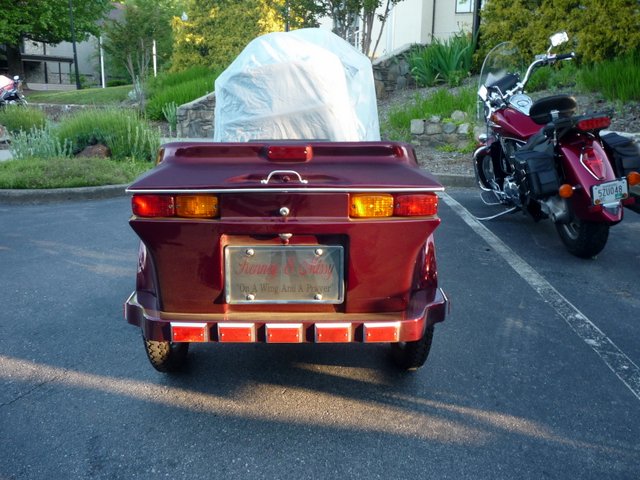
 This trailer is pulled by a GoldWing, so their slogan is "On a wing and a prayer." 
This must be a woodworker's bike, with this fancy rack.

I spot the cross, high on the hill behind the conference center.
Inspirational. 

The weather is cool but not cold.  I have hooked up with a group of about twelve bikes and we are headed to Hot Springs North Carolina for lunch.  That is a large group, and I don't like that, but I tag along anyway.  The route to Hot Springs is freeway and bland two lane roads. 

We stop to eat at the Smoky Mountain Diner, a pretty good place where a lot of motorcyclists stop for the same reason as we have today -- to use the bathroom...oh, and eat. Before we go in, I spot a little yellow dirt bike in the carport of the house next door to the restaurant.  While we are eating, I hear the buzz of a small engine.  Sure enough a little tyke has cranked up his bike and is touring his back yard.
He makes several laps.  I wonder if that NO TRESPASSING sign on that steep hill is aimed at him.  If he hasn't tried to climb it yet, I'll bet it has been on his mind.

Soon, he notices that I am taking his picture, and he starts hamming it up.
The look on his face is priceless.  One day he will be a good rider, having started at such an early age.

We finish up lunch, and head back to the bikes.  NC-209 and NC-63 are both very twisty in places, and the group is going slow.  We could have enjoyed a little more spirited ride, but maybe that will come on another day.

Here is the route, 134 miles:

View Larger Map of Route to Hot Springs

We return to the conference center and head to a seminar.  I have picked one put on by Dan Daugherty, a former Marine, cop, and now lawyer   His topic is Gun Safety and Motorcycle Carry Considerations.  The room is filled to capacity with standing room only.  That speaks to the interest in our second amendment right to bear arms. 

Later, after supper, we again gather for some song and to hear the speaker, Tommy Bowden, former head coach of Clemson University football.  He speaks of the acronym C.A.R.D.S., standing for Commitment, Accountability, Responsibility, Discipline, and Sacrifice.  These attributes can be used in coaching, but also apply to real life.  These are some things a Christian should do to truly become God's hands. 

Afterward, we chew the fat some more, and soon enough go back to our rooms for some rest.  The rooms are as good as any hotel, but there is one thing missing.  On purpose.  A television.  There is no sense coming to a place like this to sit in front of the tube.  There are places to go, things to see, sermons to be heard, and knees to be bent. 

My roommate, Danny isn't back by the time I have fallen asleep -- about five minutes after I hit the pillow, I estimate.  Had I known where he had gone, I would have worried -- and prayed.  He and another fellow started out toward Marion, NC and from there up NC-80 to the Parkway.  (That is the road I turned off on from the Parkway yesterday on my way here.)  In the dark of evening. 

Remember that 80 is very twisty.  Missing a curve could be serious.  At night, there is the possibility of animals on the highway.  The next morning, Danny said it was one of the most incredible evenings he had spent in his life.  The road on the way up was illuminated by the powerful driving lights of the other guy's touring bike ahead of him, but the striking thing, he says, was the incredible quiet and beauty of the sky up on the Parkway.  They had prayer at this place a little closer to God, then navigated back to the camp and to bed.  Safely. 

Thank you, God, for their safety and for the day's activities.

More to come soon.   Keep watching. 


Links to related postings:

Rally to Ridgecrest, 2013 -- Day 1
Rally to Ridgecrest, 2013 -- Day 2
Rally to Ridgecrest, 2013 -- Days 3 and 4

Freedom is Never Free! -- Rally to Ridgecrest, 2011, Part I
Freedom is Never Free! -- Rally to Ridgecrest, 2011, Part II

Rally to Ridgecrest Facebook Page

Memorial Day 2010 Weekend Rally
Memorial Day 2010 Weekend Rally, Part II, The Ride Up
Memorial Day 2010 Weekend Rally, Part III, Saturday
Memorial Day 2010 Weekend Rally, Part IV, Sunday and the Ride Home.

.
.